Cat On Chair Made \$18K in a Month: Vibe-Coded with ChatGPT (Case Study)
September 29, 2026 · 1323 words
| Field | Detail |
|---|---|
| What it is | Cat On Chair: an iPhone pomodoro focus timer where a cartoon cat sits with you while you work |
| Builder | Non-developer (Ryan, former product designer, plus his girlfriend, an illustrator) |
| AI tool | ChatGPT Pro for coding |
| Stack | iOS app, RevenueCat for paywalls and subscriptions, an ASO tool; rest not disclosed |
| Time to launch | About 3–4 months (started May 2025, launched Aug 27, 2025) |
| Revenue | ~$18K in the 30 days before Apr 13, 2026; ~$80K over 8–9 months; ~127K downloads (self-reported, Starter Story) |
| Source | Starter Story episode summary |

Cat On Chair made about $18,000 in 30 days, according to its founder's Starter Story interview. Over its first eight to nine months, it earned roughly $80,000 from about 127,000 downloads.
The app is a pomodoro timer. That's a focus method where you work for 25 minutes, then take a short break. There are hundreds of these apps. This one has a cat.
It was built by Ryan, a former product designer, and his girlfriend, an illustrator. Ryan had no traditional engineering background. He used ChatGPT Pro to write the code.
The core point: in a crowded category, taste and art can be the product, and AI now lets a designer ship it alone.
The problem: focus apps feel like a supervisor
Most focus timers are strict. They count down, block distractions and nag you. Cat On Chair takes the opposite angle. Its website pitches companionship rather than supervision.
When you start a session, a cat appears on the chair next to your desk. Finishing tasks earns gifts you can spend on decorating the room. The App Store listing also lists app and website blocking, to-do lists and a timeline of your sessions.
So the "problem" isn't that timers don't exist. It's that focusing feels lonely and joyless. A cozy, game-like room fixes that for a certain kind of user.
How it was built
Ryan started in May 2025 and launched on August 27, 2025, after about a month of beta testing. He came from product design at tech startups, so he could design every screen himself. His girlfriend, a fan of cozy games like Animal Crossing, drew the art.
The missing piece was code. According to the episode summary, Ryan used ChatGPT Pro for coding and credits AI with moving him from designer to builder. That's worth noting: this wasn't an AI code editor like Cursor. It was a chat assistant, used for a full native iPhone app.
It wasn't smooth. The summary says stability problems after launch, including data sync bugs, lasted until December or January. That's a common pattern for first apps built with AI help. The happy path works quickly. The edge cases take months.
The rest of the tool list is lean:
- RevenueCat handles paywalls and subscriptions. It's a service that manages in-app purchases for you. He reports it costs about $200–300 a month at this revenue.
- An ASO tool for about $10 a month. ASO (App Store Optimization) is SEO for app stores: picking the words that help people find you.
- A free user-feedback tool.
How it makes money
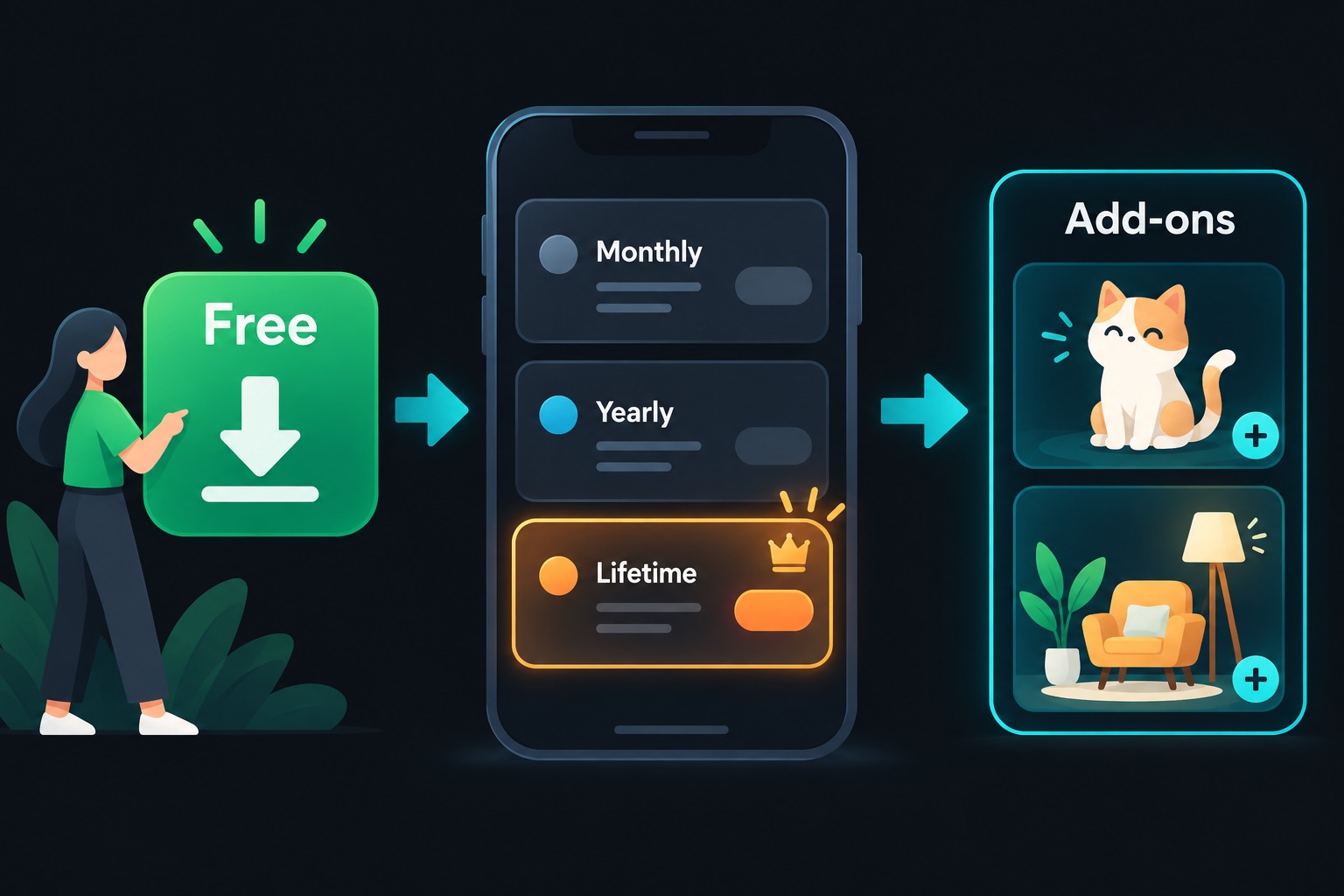
The app is free to download. Pro features sit behind a paywall with several options. Here's the current App Store list:
| Purchase | Price |
|---|---|
| Monthly Pro | $2.99 |
| Quarter Pro | $9.99 |
| Annual Pro | $19.99 |
| Lifetime Pro | $29.99 |
| Lifetime Pro for Family | $39.99 |
| Extra cats / decor sets | $2.99 / $1.99 |
Two things stand out.
Lifetime is the bestseller. The summary says the lifetime plan drives most revenue. At $29.99, it costs only $10 more than a year. For a small, cozy app, a one-time price feels safe to buyers. It also brings cash in up front.
Small add-ons add up. Individual cats and decoration sets turn the app into a light collection game. Each purchase is tiny. Together, they give fans something to keep buying after Pro.
The App Store shows a 4.9 rating from 416 ratings. The listing is available in 11 languages, which matters for the next section.
First users: an existing audience in Asia
Launch week brought about 3,000 downloads. They came from his girlfriend's existing following on RedNote (Xiaohongshu), a Chinese social app. Chinese and Taiwanese users became the main market.
Then came two more waves. A user in Taiwan reshared the app on Threads, which the summary says doubled downloads overnight. Later, Instagram influencers featured it in "app collection" posts, and one of those reached over 2 million views. At its peak, the app hit #3 in free productivity apps in Taiwan.
None of this was paid acquisition. The art was shareable, and the audience already existed.
What to copy
- Build from a skill you already have. Ryan's design eye and his girlfriend's art made something competitors can't copy with a prompt.
- Pick a crowded category and change the feeling, not the feature. A pomodoro timer is simple. A cat on a chair is memorable.
- Launch to an audience you already have. 3,000 first-week downloads came from one existing account.
- Offer lifetime pricing close to the annual price. Test whether your buyers prefer paying once.
- Localize early. Eleven languages let viral moments in one country actually convert.
- Budget months for stability. AI got the app out the door. Fixing sync bugs took until winter.
If you vibe-code this
Cat On Chair collects little data. The App Store privacy label lists only usage and diagnostics, not linked to identity. Still, any paid iPhone app has a few checks that matter. These are general, not a comment on this app.
- Never unlock Pro with a local flag. A value saved on the device can be flipped. Ask your purchase service, which validates receipts on its servers.
- Ship only public SDK keys. RevenueCat's public app key is meant for the app. Its secret key must never be in your code. See environment variables security.
- Store tokens in the Keychain, not plain storage. See secure storage on mobile.
- Lock down sync. If you sync data through Firebase, each user must only reach their own records. See Firebase security rules.
- Vet every package the AI adds. See supply-chain security.
A correct Pro check with RevenueCat in Swift:
import RevenueCat

// RevenueCat validates receipts server-side; don't trust a local Bool.
let info = try await Purchases.shared.customerInfo()
let isPro = info.entitlements["pro"]?.isActive == true
Building a paid iPhone app with AI and want someone to check it before launch? Email [email protected] for a security audit.
Key takeaway
Cat On Chair didn't win on features. It won on feel: a designer's polish, an illustrator's cat, and an audience that already loved their style. ChatGPT Pro closed the coding gap. If you have a craft, AI can now turn it into an app that pays.
More case studies: Vibe-coded apps making money · Before you launch: Vibe coding security guide
Sources
- Starter Story episode summary, "$18K/month from this ridiculously simple app idea" (Jul 26, 2026): https://www.bulletpointpodcast.com/starterstory/18-k-month-from-this-ridiculously-simple-app-idea
- Original Starter Story video: https://www.youtube.com/watch?v=V_4kiR3R4QU
- Cat On Chair on the App Store: https://apps.apple.com/us/app/cat-on-chair-pomodoro-timer/id6746562271
- Cat On Chair website: https://catonchair.app/en/