Vibe Coding Security: How to Ship Secure AI-Generated Code in 2026
July 8, 2026 · 1471 words
Vibe coding security is the difference between shipping fast and shipping a data breach. When you describe a feature and let an AI write it, the model optimizes for working code — not safe code — so vulnerabilities slip in quietly. This guide covers exactly why AI-generated code is risky, the specific flaws to watch for, and a concrete workflow to catch them before you deploy.
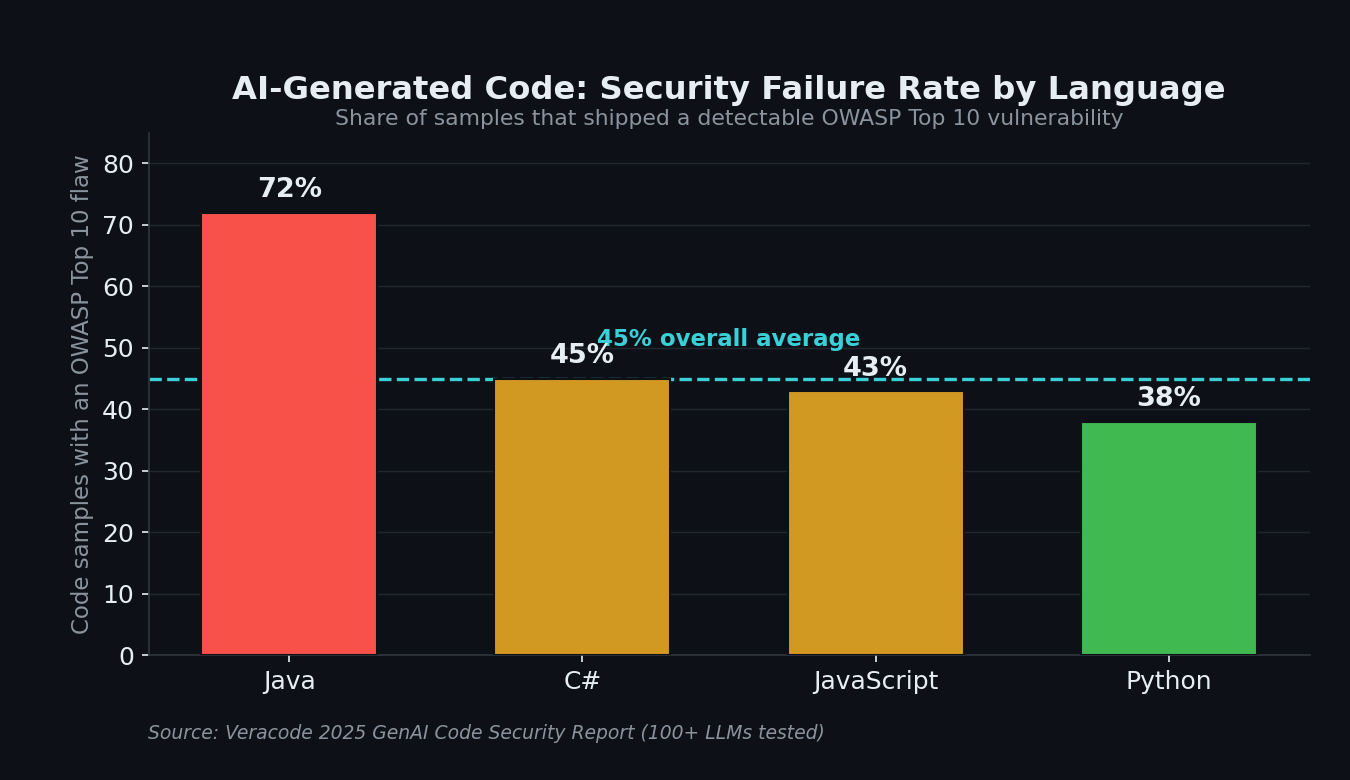
The productivity story is real. But so is the risk: in Veracode's 2025 GenAI Code Security Report, researchers tested over 100 large language models across Java, Python, C#, and JavaScript and found that 45% of AI-generated code samples introduced an OWASP Top 10 vulnerability. More sobering: newer, larger models were no better at writing secure code than older ones. Security performance stayed flat regardless of model size — meaning you can't wait for the next model release to fix this. You have to build security into your workflow now.
Why Vibe Coding Creates a New Class of Risk
Traditional bugs come from developers who understand the code and make mistakes. Vibe coding vulnerabilities are different: they come from generated code the author may not fully read, produced by a model trained on billions of lines of public code — including all the insecure patterns. The AI reproduces those patterns confidently, with clean formatting and plausible variable names that make bad code look trustworthy.
Independent analyses back this up. IBM's writeup on vibe coding security risks argues these risks aren't like ordinary ones precisely because volume and speed outpace review, and Forbes has covered how vibe coding has a massive security problem as non-engineers ship production apps they can't audit. Security vendor analyses such as OX Security's breakdown report that a majority of AI-generated code ships with at least one weakness when left unreviewed.
The core problem is a mismatch of incentives. You prompt for a feature; the model gives you the shortest path to that feature working. "Secure" is rarely in the prompt, so it's rarely in the output.
The Most Common Vibe Coding Vulnerabilities
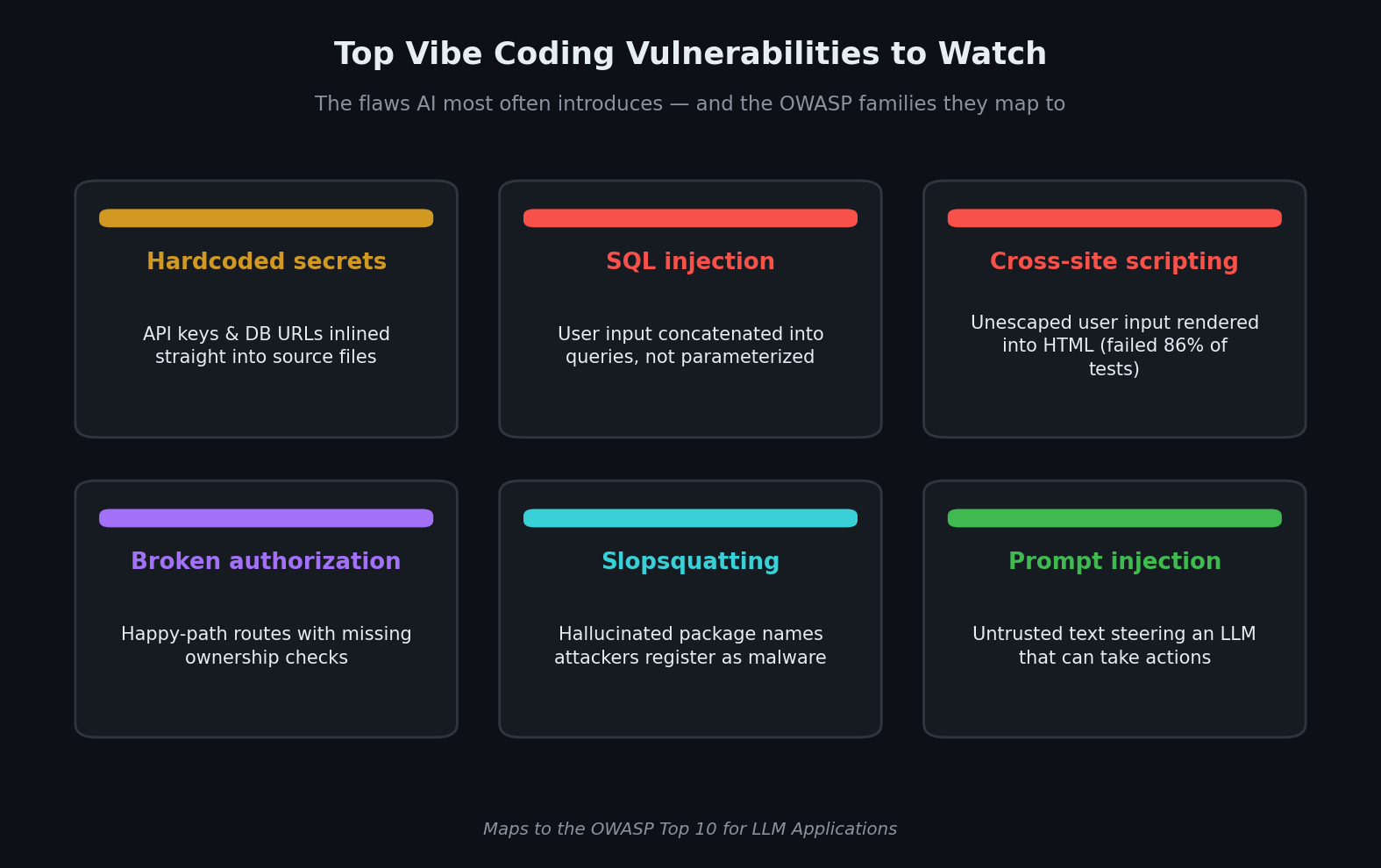
Most AI-introduced flaws cluster into a handful of categories that map cleanly onto the OWASP guidance. The OWASP Top 10 for LLM Applications frames the risks specific to LLM-driven development — prompt injection, insecure output handling, sensitive information disclosure, and more. Here are the ones that show up most in day-to-day vibe coding:
| Vulnerability | Why the AI produces it | How to catch it |
|---|---|---|
| Hardcoded secrets | The model inlines an API key or DB URL to make the example "run" | Secret scanners (gitleaks, trufflehog); grep for keys before commit |
| SQL injection | It concatenates user input into a query string instead of parameterizing | SAST rules; review every DB call for parameterized queries |
| Cross-site scripting (XSS) | It renders user input directly into HTML without escaping | SAST + manual review of any dangerouslySetInnerHTML / raw output |
| Missing authorization | It builds the happy path and forgets to gate routes | Check every endpoint has auth and ownership checks |
| Slopsquatting | It hallucinates a package name that doesn't exist | Verify every dependency exists and is the real maintainer's package |
| Prompt injection | Your app feeds untrusted text into an LLM that can take actions | Treat model output as untrusted; least-privilege tools; human approval |
Cross-site scripting deserves a special mention: in Veracode's testing, models failed to defend against XSS (CWE-80) in 86% of relevant samples. If your AI-generated frontend takes user input and renders it, assume it's vulnerable until you've verified escaping.
Prompt for Security From the Start
The cheapest fix is the earliest one. A generic prompt gets you a generic — and insecure — implementation. Naming the security requirements in the prompt itself measurably improves what the model produces. Compare these two:
| Insecure prompt | Security-aware prompt |
|---|---|
| "Add a login endpoint." | "Add a login endpoint. Hash passwords with bcrypt, use parameterized queries, rate-limit to 5 attempts/min per IP, and return a generic error on failure. No secrets in code — read them from process.env." |
| "Let users upload a profile photo." | "Add a profile photo upload. Validate MIME type and size server-side, store outside the web root, generate a random filename, and never trust the client-provided filename." |
A reusable security checklist you can paste into any coding agent:
SECURITY CONSTRAINTS (apply to all code you write):
- No hardcoded secrets. Read all keys/URLs from environment variables.
- Parameterize every database query. Never build SQL by string concat.
- Validate and sanitize all user input on the server side.
- Escape all output rendered into HTML.
- Every route needs authentication AND authorization (ownership) checks.
- Use only real, existing packages. List any new dependency you add.
- Return generic error messages; never leak stack traces to the client.
This turns security from an afterthought into part of the spec — the same principle behind treating every prompt as a mini-spec, which we cover in How to Prompt for Vibe Coding.
A Secure Vibe Coding Workflow
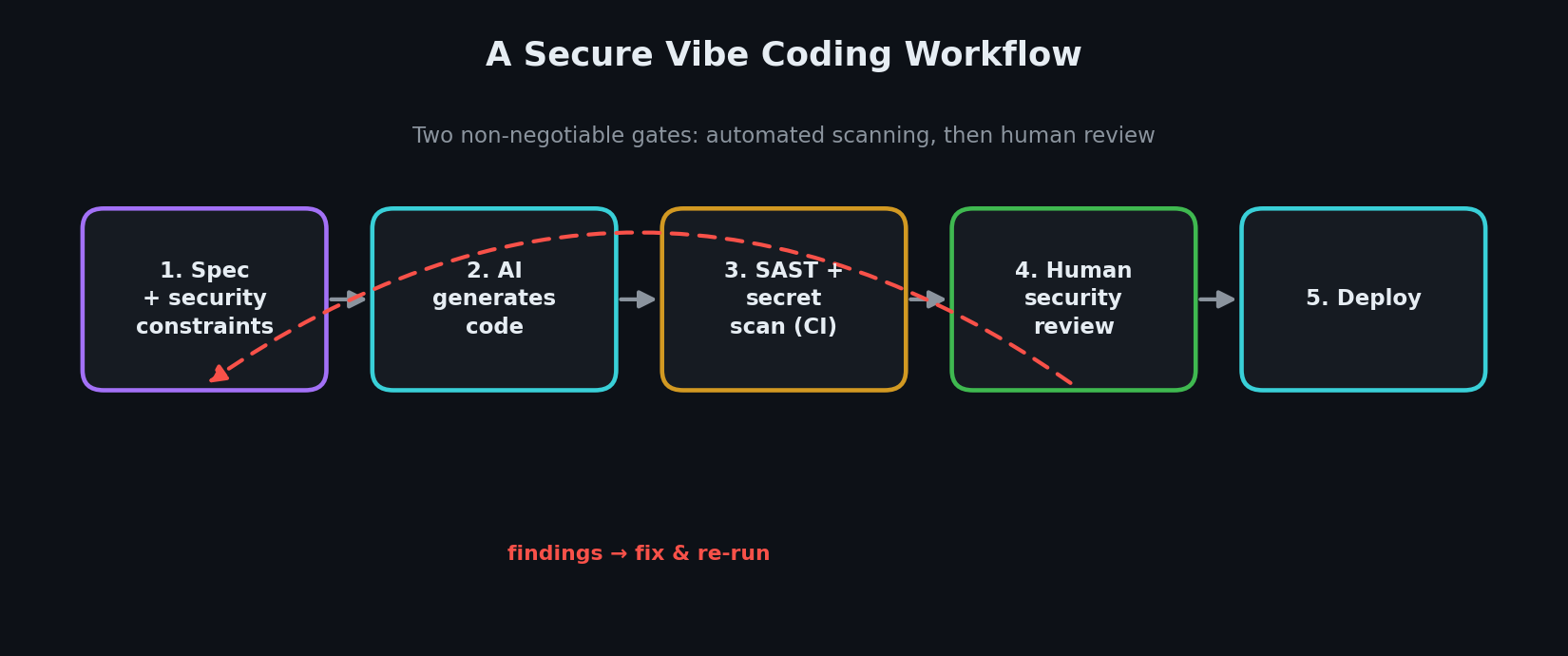
Prompting well reduces the flaw rate; it doesn't eliminate it. You still need a verification layer between "the AI wrote it" and "it's in production." The loop below adds two non-negotiable gates — automated scanning and human review — without slowing you to a crawl.
1. Scan automatically in CI
Wire a static analysis (SAST) tool into your pipeline so nothing merges unscanned. Semgrep with an OWASP ruleset and SonarQube security hotspots catch injection and XSS patterns; gitleaks or trufflehog catch secrets, including ones buried in git history. Checkmarx's guidance on security in vibe coding recommends making these scans a blocking check, not an advisory one.
# Fast local pre-commit sweep for the two highest-frequency issues
semgrep --config "p/owasp-top-ten" .
gitleaks detect --source . --no-banner
2. Manage secrets outside the code
Because hardcoded credentials are the single most common AI-introduced flaw, standardize on environment variables and a secrets manager from day one. Keep a committed .env.example with placeholder keys, add real .env files to .gitignore, and rotate any key the moment it lands in a diff — the AI will try to inline a key to make an example run, so assume it happens and scan for it.
3. Verify dependencies before you install
Roughly one in five AI code samples references a package that doesn't exist — a hallucination attackers exploit by pre-registering those names as malware ("slopsquatting"). Before running npm install on anything the AI suggested, confirm the package exists, check its download count and repository, and make sure it's the real maintainer's.
4. Review like you wrote it
Automated tools miss business-logic flaws — the broken access control where user A can read user B's data. That requires a human who understands intent. Read every AI diff, run it, and specifically check authorization on each route. A useful pattern is a fresh-context review: have one session generate the code and a separate session audit it against your security checklist, so the reviewer isn't just rubber-stamping its own reasoning.
Security Scanning Tools at a Glance
You don't need all of these, but you need at least one from the SAST row and one from the secrets row.
| Tool | Category | Best for |
|---|---|---|
| Semgrep | SAST | Fast, rule-based scanning with a strong free OWASP ruleset |
| SonarQube | SAST / quality | Security hotspots plus broader code-quality gating in CI |
| gitleaks | Secret scanning | Catching hardcoded credentials in code and git history |
| trufflehog | Secret scanning | Deep secret detection with verification of live keys |
| npm audit / OSV | Dependency | Flagging known-vulnerable and suspicious packages |
The goal isn't to bury yourself in tooling — it's to make "did we scan this?" a yes/no gate that a fast-moving vibe coding workflow can't skip.
Key Takeaway
Vibe coding is a genuine accelerant, but the model is optimizing for works, not safe — and the data shows that gap doesn't close with bigger models. Treat every line of AI-generated code as unreviewed until proven otherwise: prompt for security explicitly, scan automatically, keep secrets out of the code, verify dependencies, and review the logic yourself. Do that and you keep the speed of vibe coding without inheriting its biggest liability. Speed without security isn't velocity — it's just risk you haven't noticed yet.
This article covers security concepts for educational purposes; always validate your specific stack against current OWASP guidance and your own threat model before shipping.