How Algrow Found 400 Users on Discord Before Hitting \$14K/mo
September 29, 2026 · 1334 words
| Field | Detail |
|---|---|
| What it is | Algrow: a YouTube research tool (find niches, spot fast-growing channels) plus AI video, image and voice generation |
| Builder | Non-developer (university student, "zero coding background") |
| AI tool | ChatGPT (voice mode) first, then Cursor |
| Stack | Heroku hosting, MailerLite email, Gemini, Nano Banana and Sora 2 for AI generation |
| Time to launch | MVP coded in about a week |
| Revenue | ~$14K in the last 30 days, 480 new customers that month (self-reported, Starter Story, Jan 2026) |
| Source | Starter Story interview |

Sam Adeniyi says Algrow made about $14,000 in its last 30 days and added 480 new customers in a single month. That was roughly six months after launch, according to his Starter Story interview. He had no coding background when he started.
The interesting part isn't the revenue. It's where the first 400 users came from: Discord voice chats, where he shared his screen and said almost nothing. This post breaks that down channel by channel, so you can copy it for your own vibe-coded app.
One core point: go where your buyers already ask the question your app answers, and show the answer instead of pitching it.
Timeline: from ChatGPT in Notepad to 400 users
Step 0 — the build. Sam started by describing his whole idea to ChatGPT in voice mode. He copied the code it gave him into Notepad, then into VS Code (a free code editor). A friend told him to switch to Cursor, an AI code editor that writes and edits code inside your project. He later moved from Cursor's $20 plan to the $200 plan.
He says the first MVP (minimum viable product: the smallest version that works) took about a week. It ran on Heroku, a hosting service that runs your app for you.
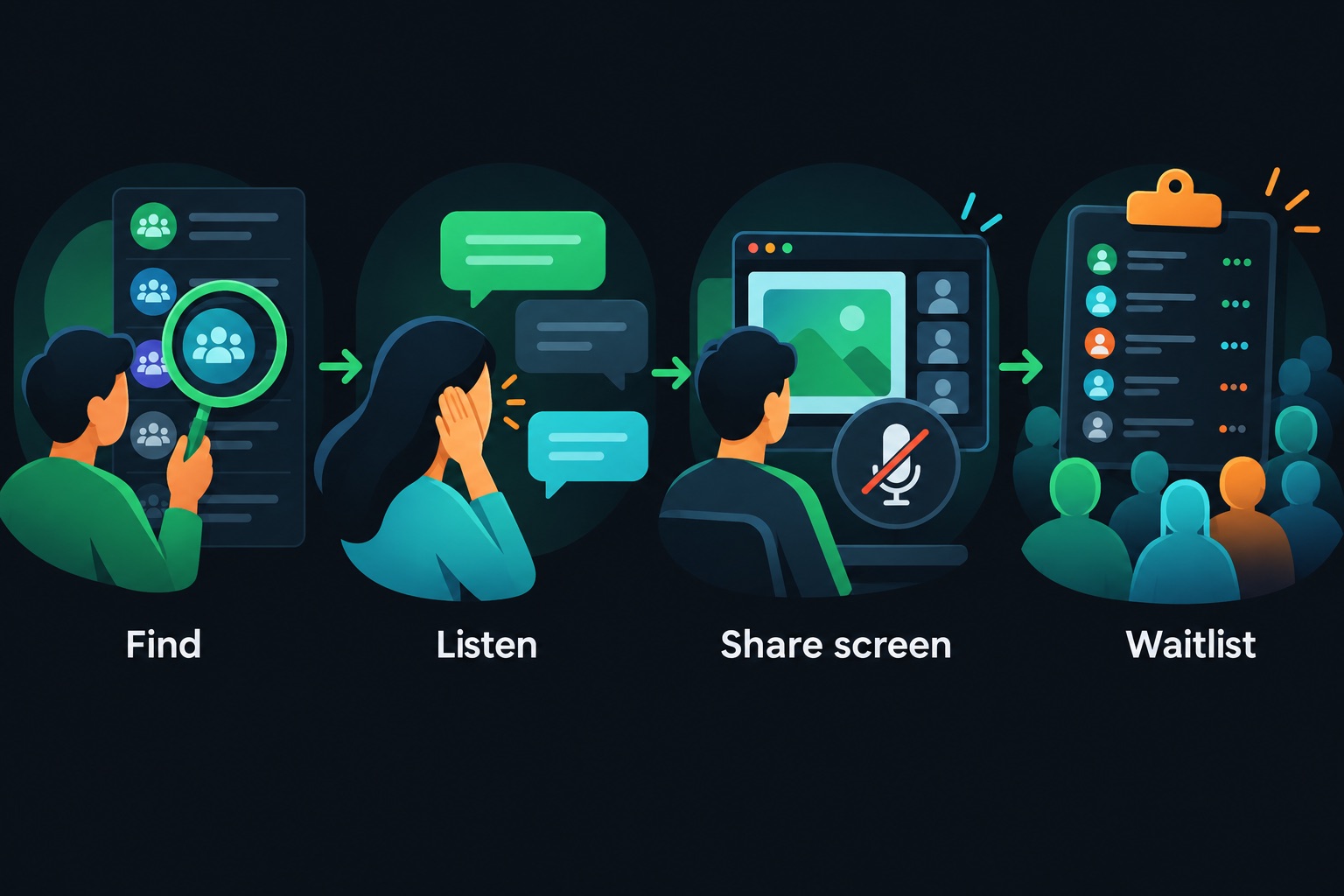
Step 1 — find the room. He searched a Discord server directory for communities full of people like his target user. He landed in a YouTube-money server where members kept asking the same thing: how do I find a niche, and how do I copy one that works?
Step 2 — listen first. His advice is to scroll the chat history before building anything. He even pasted chat logs into ChatGPT to spot recurring pain points. That told him which feature to show first.
Step 3 — screen-share, don't pitch. He joined voice channels, muted his mic, and shared his screen while using his own tool. People asked what he was using. He answered that he built it. The demo did the selling.
Step 4 — waitlist. After about a week of this, he dropped a waitlist link in the chat for anyone who wanted to try it.
Step 5 — free access for early fans. Early users got free accounts so they could show the tool to friends. He says his first 400 users all came from Discord. The server owner even made a long-form YouTube video about the tool.
What worked
Showing beat telling. A silent screen share answers "does this work?" faster than any landing page. Viewers see real data on real channels. For a research tool, the output is the ad.
Picking a room with one repeated question. "How do I find a niche?" came up again and again. Algrow's core feature answers exactly that. When your app maps to a question people ask daily, you don't need a clever hook.
Turning users into demo-givers. Free early access sounds like lost revenue. Here it created people who screen-shared the tool to their own friends. That is word-of-mouth you can actually trigger.
Shipping before it was polished. Sam's first user hit an application error. The core idea still worked, and he kept going. For a first launch, "useful with bugs" beat "perfect and unseen."
What flopped (or could have)
The interview doesn't list failed channels. It focuses on Discord. So I won't invent any.
The one stumble he names is the buggy MVP. His later advice is to build as if you'll have 100,000 users. In other words, plan for scale earlier than he did.
There is also a risk worth naming. Promoting inside someone else's server depends on their rules and goodwill. Sam's advice includes building your own Discord server, which lowers that risk over time.
Copy this: a Discord playbook for your first 100 users
- Write one sentence about your buyer. Then search a Discord server directory for that phrase.
- Lurk for a few days. Read the chat history. Note the top three repeated questions.
- Check the rules. Some servers ban self-promotion. Respect that, or ask a moderator first.
- Demo in voice, quietly. Share your screen while solving one of those questions with your app.
- Offer a waitlist, not a price. Let curious people opt in.
- Give early users free access in exchange for feedback. Ask them to show it to one friend.
- Open your own server once people start asking you questions directly.
- Start charging once people use it without you in the room. Algrow's paid plans today run $25, $45 and $80 a month.
If you vibe-code this
Algrow is a credit-based app: users buy credits, and each AI generation spends some. Apps like this resell expensive AI APIs (paid services you call from code). That makes a few checks important for this type of app. This is general guidance, not a claim about Algrow.
- Deduct credits on the server, atomically. "Atomic" means the check and the subtraction happen in one step, so two fast requests can't both spend the same credits.
- Rate-limit generation endpoints. A rate limit caps how many requests one user can send per minute. Without it, one script can burn your AI bill overnight. See API rate limiting in Next.js.
- Keep AI provider keys server-side. Never put them in browser code or a public env variable. See environment variables security.
- Grant credits only from a verified payment webhook. A webhook is the message Stripe sends your server after a payment. Verify its signature first. See Stripe webhook security.
- Check ownership on every generated file. User A should never load User B's videos by changing an ID in the URL. See IDOR authorization.
Here is the credit check in one query, using Prisma (a database library):
// Deduct credits BEFORE calling the paid AI API.
// The WHERE clause makes check + subtract one atomic step.
const updated = await prisma.$executeRaw`
  UPDATE "User" SET credits = credits - ${cost}
  WHERE id = ${userId} AND credits >= ${cost}`;

if (updated === 0) {
  return Response.json({ error: "Not enough credits" }, { status: 402 });
}
// ...now call the AI provider
The tagged template (the backticks right after $executeRaw) keeps values parameterized. Writing raw SQL any other way invites injection; see Prisma raw query SQL injection.
Building a credit-based AI app and want a second pair of eyes? Email [email protected] for a security audit.
Key takeaway
Algrow's first 400 users didn't come from ads or a launch post. They came from quietly showing a working tool in rooms where people asked the exact question it answers. Find that room for your app, listen first, and let the screen share do the talking.
More case studies: Vibe-coded apps making money · Before you launch: Vibe coding security guide
Sources
- Starter Story interview with Sam Adeniyi (Jan 15, 2026): https://www.starterstory.com/sam
- Episode summary, "I built a $14K/month SaaS using Discord": https://www.bulletpointpodcast.com/starterstory/i-built-a-14k-month-saas-using-discord
- Algrow homepage and pricing: https://algrow.online/