How TradeWeave Was Vibe-Coded with Bolt: Stack, Pricing and First Users
October 7, 2026 · 1259 words
| Question | Answer |
|---|---|
| What it is | An EDI platform for trucking carriers, replacing expensive legacy integration software |
| Builder | Non-developer (transportation consultant and solution architect, building with his two sons) |
| AI tool | Bolt.new |
| Stack | Bolt.new; the rest not disclosed |
| Time to launch | Not disclosed. Feasibility answered two days into the build |
| Revenue | Not disclosed. About 8 customers, 6 of them big carriers (self-reported, Aug 2026). Price: about half of a $70K/yr incumbent; exact price not public |
| Source | Bolt customer story, Aug 14, 2026 |

TradeWeave has about eight customers, and six of them are big trucking carriers moving off legacy systems. It was built on Bolt.new by Paul, a transportation consultant, and his two sons. Its pitch is simple: it does what a $70K-a-year tool does, at about half the price.
The revenue isn't public, and neither is the exact price. The source is a customer story published by Bolt, the tool vendor, so read it with that in mind. Even so, it is one of the clearest examples of a non-developer using an AI builder to go after a large, boring B2B market.
The problem: EDI costs too much
Trucking runs on EDI, or electronic data interchange. EDI is a set of standard formats that companies use to swap shipping orders, status updates and invoices between their systems. Carriers need it to work with shippers.
The tools for it are old and expensive. The Bolt story names the incumbent, Dell Boomi, at $70,000 a year. API connectivity adds another $20,000-a-year license. The headline frames TradeWeave as saving clients from a $70K SaaS subscription.
Paul spent more than a decade as a transportation consultant. He specialized in EDI workflows and industry software. In other words, he knew exactly what the expensive tool did, and where it fell short.
How it was built
Paul is clear about his background. In the Bolt story he says: "I'm not a developer by trade." He describes himself as more of a solution architect, someone who designs how systems fit together.
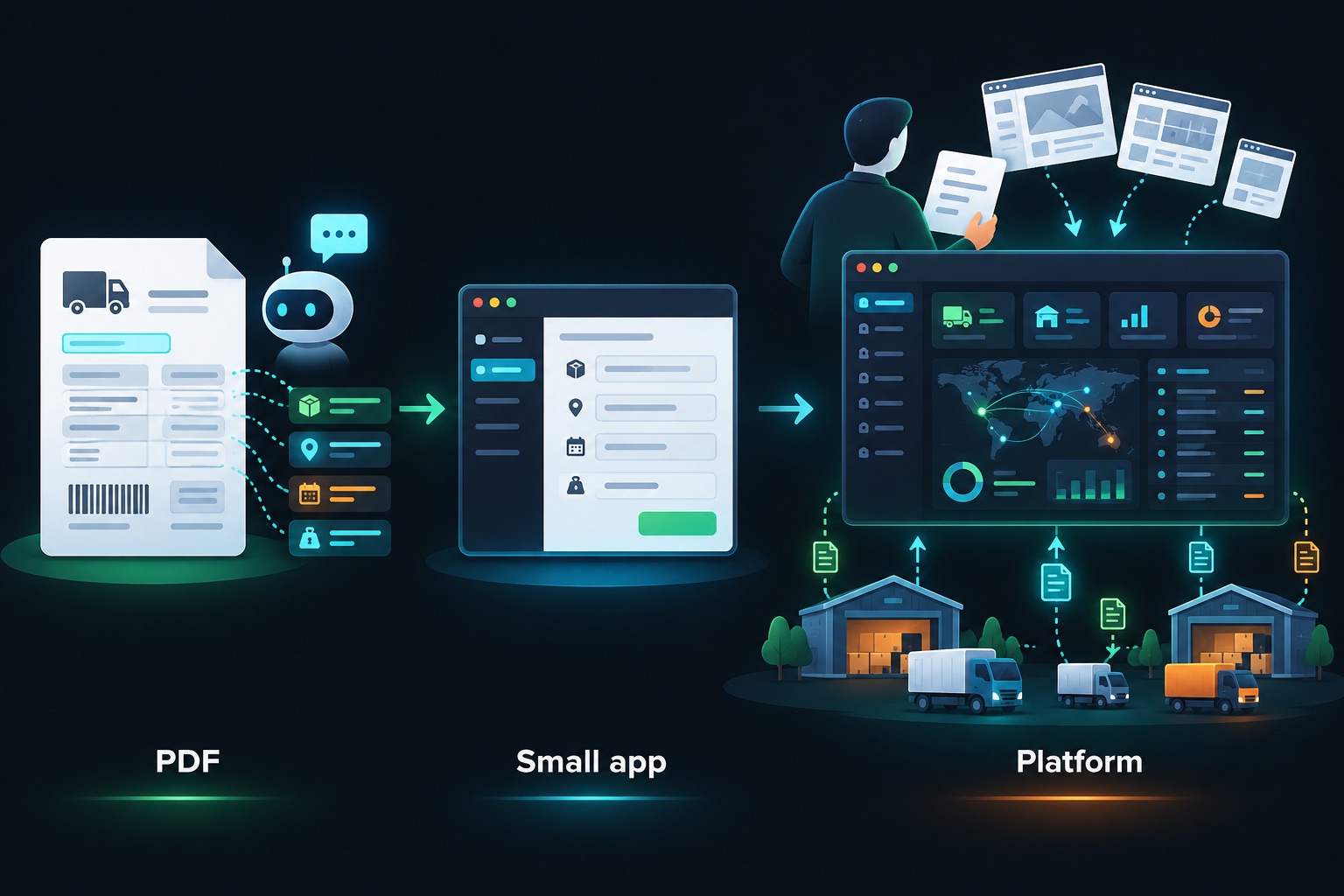
His first AI project wasn't EDI at all. He uploaded a shipping PDF to an AI chatbot and asked it to pull out the shipper, consignee and freight details. It worked. So he found Bolt.new and built a document-processing app that fixed a daily headache for his clients. The story says about ten of them still use it.
That led to a bigger question. If AI could read freight paperwork, could it build the software his industry had been overpaying for since the '90s?
Bolt.new is an AI app builder that runs in the browser. You describe what you want, and it writes and runs a full web app. Paul built TradeWeave the way he advises clients to spec software. He told the AI how it needed to work and how it needed to look. He also fed it screenshots of software he liked. Two days into the build, he had his answer: it was possible.
Beyond the core EDI tool, the team built their own internal tools as they needed them:
- a support ticketing system
- a licensing system
- a deployment comparison tool
- KPI dashboards (charts of key business numbers)
The rest of the stack isn't disclosed.
It is a family team. Paul's oldest son builds alongside him. His youngest, a software development student in Vancouver, spent the summer doing EDI mapping between semesters. EDI mapping means translating one company's data format into another's.
How it makes money
TradeWeave sells to carriers. The exact price isn't public. I couldn't find a pricing page. The story says it costs about half as much as the $70K incumbent.
That positioning does a lot of work. A buyer doesn't need to understand a new category. They already pay for the old tool. TradeWeave just has to do the same job for less, with features Paul always wished the incumbent had.
About eight customers are signed, and six are big carriers. The story does not give revenue, contract length or price per customer. I won't guess at them.
First users: a decade of relationships
The story doesn't mention ads or launch posts. It credits Paul's decade in the industry and the relationships that came with it.
The earlier document-processing app also matters. It put an AI-built tool into his clients' daily work before TradeWeave existed. The story doesn't say how many of those clients became TradeWeave customers, so I won't connect the two.
The story also has a telling detail. Paul was planning to walk a transportation trade show in September with no booth. After a decade in the industry, he doesn't need one to find customers.
What to copy
- Sell against a known, expensive incumbent. "Half the price of the tool you already pay for" is the easiest pitch in B2B.
- Use your domain knowledge as the moat. The AI wrote the software. Paul knew what the software had to do.
- Start with a small tool. The document-processing app proved the idea before the big build.
- Spec like an architect. Describe how it should work, show screenshots of what you like, and iterate.
- Build internal tools only when you need them. Ticketing, licensing and dashboards came as the business grew.
If you vibe-code this
An EDI or B2B data-exchange app moves shipment and billing data between companies. Here is what I would check in any app of this type. This is about the category, not TradeWeave.
- Validate every inbound message. Partner data is untrusted input. Check its shape, types and size before you store it. See Zod input validation.
- Isolate each partner. A carrier should never see another carrier's shipments. See API route IDOR.
- Give each partner its own credentials. Keep them on the server and rotate them. See environment variables.
- Rate-limit partner endpoints. One misbehaving integration shouldn't take down the rest. See API rate limiting.
If your integration also accepts JSON over an API, item 1 looks like this:
import { z } from "zod";

const ShipmentStatus = z.object({
  partnerId: z.string().uuid(),
  shipmentId: z.string().max(50),
  status: z.enum(["PICKED_UP", "IN_TRANSIT", "DELIVERED"]),
  timestamp: z.string().datetime(),
});

export async function POST(req: Request) {
  const parsed = ShipmentStatus.safeParse(await req.json());
  if (!parsed.success) {
    return Response.json({ error: "Invalid payload" }, { status: 400 });
  }
  // Next: check the authenticated partner matches parsed.data.partnerId
  return Response.json({ ok: true });
}
Building a B2B tool that moves other companies' data? I review vibe-coded apps before launch. Email [email protected].
Key takeaway
TradeWeave shows where AI builders shine: in the hands of someone who deeply knows an expensive, boring problem. Paul isn't a developer by trade. But ten years of EDI work, Bolt.new and a half-price pitch got him about eight customers.
More case studies: Vibe-coded apps making money. Before you launch: Vibe coding security guide.