How AppAlchemy Got Its First Users: Reddit, One Tweet, \$10K MRR
October 7, 2026 · 1274 words
| Fact | AppAlchemy |
|---|---|
| What it is | Browser-based AI builder for React Native mobile apps, with live phone preview and code export |
| Builder | Developer (Diego Roshardt; self-taught from YouTube, briefly a startup software engineer) |
| AI tool | Claude Code and Cursor |
| Stack | React MVP, now Next.js; Supabase (moved from Firebase). Payments and hosting not disclosed |
| Time to launch | ~2 weeks for the MVP |
| Revenue | $10K+ MRR within about a year of launch (self-reported) |
| Pricing | Pro $20/month (100 credits), Max $200/month (1,000 credits) (pricing page) |
| Source | Indie Hackers interview |

AppAlchemy passed $10,000 in monthly recurring revenue (MRR) within about a year of launch. MRR is the subscription money that comes in every month. The figure is self-reported in a July 2026 Indie Hackers interview.
The founder, Diego Roshardt, built the first version in about two weeks. He develops with Claude Code and Cursor. He charged from day one.
This post is about how the first users found it. The one point: Reddit got him the first trickle, and one influencer post turned the trickle into a wave, but only because the product was already live and charging.
Where he started
Roshardt learned to code mostly from YouTube. He launched several projects in college, and most failed. After graduating he worked briefly as a software engineer at a startup. Then he quit, with only a few months of runway (savings to live on), to build AppAlchemy.
The problem he picked was his own. Building a mobile app meant installing Xcode and owning a decent Mac. AppAlchemy lets you build a native app from a browser instead.
Today you describe your app in a chat. The AI builds it in React Native, a framework for iOS and Android apps. You preview it live on your phone and can export the code. The homepage claims 230,000+ people building and 110,000+ apps created. Those are the company's own numbers.
The channel timeline
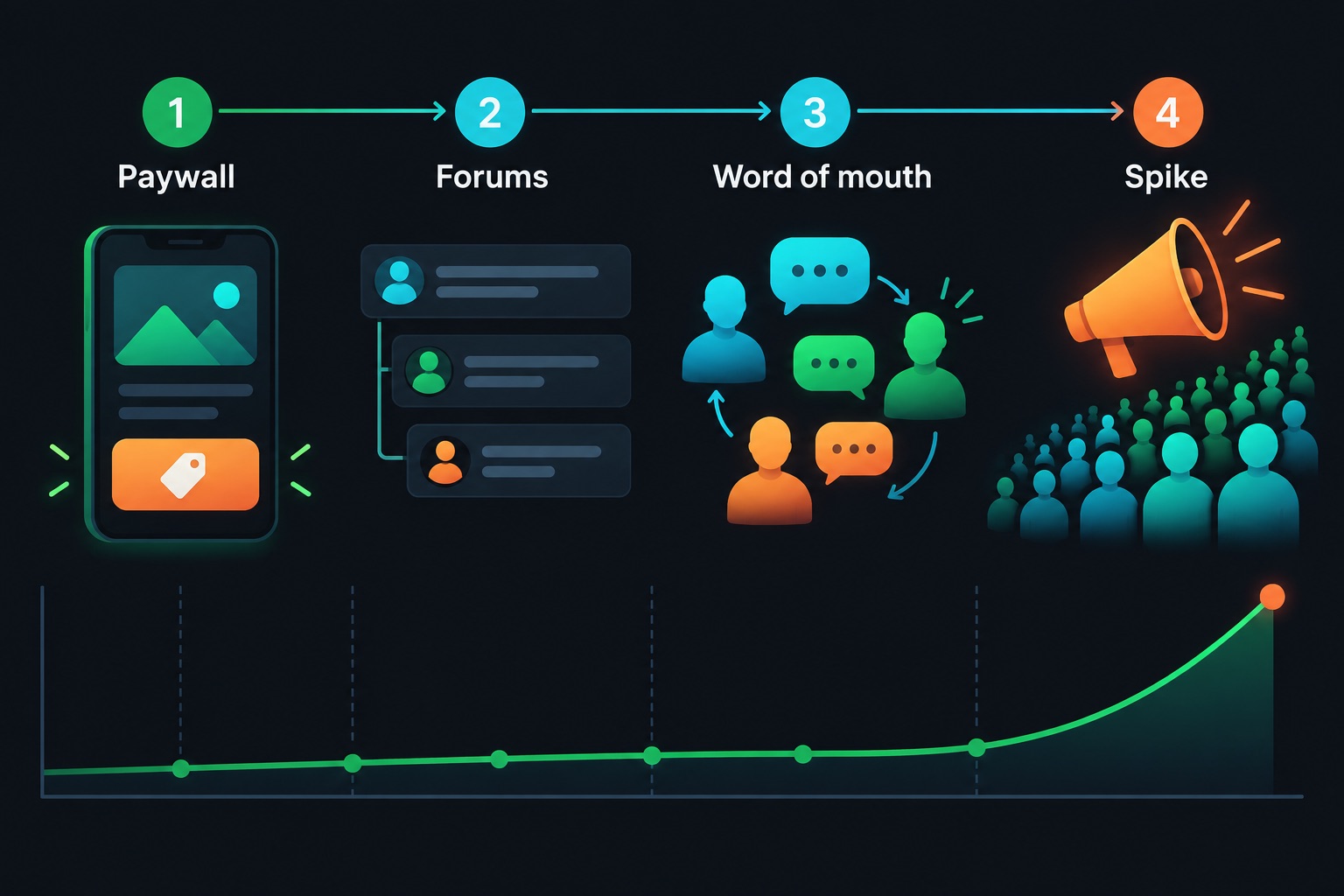
The interview doesn't give user counts per channel, so here is the order of events as he describes it.
1. Launch with a paywall (day one). The first MVP was a simple React app, built in about two weeks. He charged immediately, with monthly plans and discounted yearly plans. His view: paying customers are what prove demand.
2. Reddit (the main early channel). Growth was slow at first, with a few sporadic paid users. Reddit is where he found them. He calls it an underrated marketing channel.
3. Word of mouth. People who liked the product posted about it on social media and shared it with friends.
4. One influencer post (the spike). A major Twitter influencer posted about AppAlchemy. He says he gained a significant influx of users overnight.
He doesn't name the influencer or give numbers for the spike.
What worked
Reddit, done as a member, not an advertiser. His advice is to become an active Reddit user first. Join the subreddits in your product's niche. When you post, lead with something useful. His exact tactic: "Provide value in your niche, then casually mention your product in the middle of the post."
That line is worth rereading. The product mention sits in the middle, not the title, and not the first sentence. The post has to be worth reading even without it.
Charging from the start. Early revenue was small, but every paying user was a real signal. It also meant that when the influencer spike came, new users landed on a working paid product.
A demo-friendly product. An app builder shows well in videos and screenshots. You type a prompt and an app appears on your phone. That makes it easy for an influencer, or a Reddit user, to share.
What didn't work (or wasn't worth it)
Slow early traction. He is open that the first stretch was a handful of scattered paying users. There was no launch-day explosion.
Product Hunt, for this audience. He is skeptical of it. His point: if your target customer isn't an entrepreneur or early adopter, Product Hunt's audience is the wrong fit.
Overbuilding. His first piece of advice is to launch in two weeks rather than keep polishing.
Copy these steps
- Ship a paid MVP in two weeks. Use Claude Code or Cursor to get there. Put a price on it immediately.
- Pick three to five subreddits where your users already hang out. Comment and help for a few weeks before you post anything about yourself.
- Write value-first posts. Teach something real. Mention your product once, mid-post, as the tool you used.
- Make the product easy to show. A 20-second screen recording beats a paragraph of features.
- Be ready for a spike. Make sure sign-up, payments and your AI costs can survive a sudden rush of new users.
Pricing today is two plans. Pro is $20 a month for 100 credits, live phone preview and code export. Max is $200 a month for 1,000 credits and priority speed. Credits are spent per message that builds or edits your app.
If you vibe-code this
AppAlchemy is the example here, not an audit subject. For any AI app builder with credit-based plans on Supabase, I'd check:
- Spend credits atomically on the server. Two fast requests must not both pass a "has credits" check. See API rate limiting.
- Lock projects to their owner. Changing a project ID in a URL must not open someone else's app. See IDOR authorization and Supabase RLS.
- Run previews of generated code away from your main domain. User-made code should never share cookies with your dashboard. See security headers and CSP.
- Expect users to attack your prompts. People will try to make the builder reveal its system prompt or keys. See prompt injection.
A Postgres function that spends credits in one atomic step, callable only by your server:
create or replace function spend_credits(p_user_id uuid, p_cost int)
returns int
language plpgsql
security definer
set search_path = public
as $$
declare remaining int;
begin
  if p_cost <= 0 then
    raise exception 'invalid cost';
  end if;
  update profiles
     set credits = credits - p_cost
   where id = p_user_id and credits >= p_cost
  returning credits into remaining;
  if remaining is null then
    raise exception 'insufficient credits';
  end if;
  return remaining;
end;
$$;

-- Only your server (service role) may call it, never the browser.
revoke execute on function spend_credits(uuid, int) from public, anon, authenticated;
Launching a credit-based AI tool? I review vibe-coded Supabase and Next.js apps before the traffic spike hits. Email [email protected] with your stack.
Key takeaway
AppAlchemy's first users came from patient, value-first Reddit posts, and its big jump came from one influencer. Neither would have paid off without a two-week MVP that was already charging.
More case studies: Vibe-coded apps making money · The security checklist: Vibe coding security
Sources
- Indie Hackers, "Launching an app builder in 2 weeks and hitting $10k MRR within a year" (July 9, 2026): https://www.indiehackers.com/post/tech/launching-an-app-builder-in-2-weeks-and-hitting-10k-mrr-within-a-year-gRWT2S68TIQwMvb6Xxt4
- AppAlchemy homepage: https://appalchemy.ai/
- AppAlchemy pricing: https://appalchemy.ai/pricing