WhimFiles' Pricing, Explained: A \$24.99 Claude Code Mac App
September 29, 2026 · 1257 words
| Field | Detail |
|---|---|
| What it is | WhimFiles: a fast, native macOS file manager with live filters, fuzzy "go to" search, dual panes and batch rename |
| Builder | Unknown (developer posting as "whimbyte"; background not stated) |
| AI tool | Claude Code |
| Stack | .NET/C# with AppKit (Apple's native UI framework), compiled with Native AOT to a ~9 MB app; Apple Silicon, macOS 12+ |
| Time to launch | Not disclosed (Show HN launch July 7, 2026) |
| Revenue | Not disclosed — $24.99 one-time, 30-day free trial (pricing page only) |
| Source | Show HN post · whimfiles.com |

WhimFiles costs $24.99, once. There's no subscription, a 30-day free trial with no card, and a 14-day refund window. It launched on Hacker News in July 2026 at $19.99 and picked up 98 points. The price has gone up since.
The developer, who posts as whimbyte, wrote in the launch post:
"I used Claude Code for making the app and the tech stack is .NET/C# with AppKit." — whimbyte, Show HN
Claude Code is Anthropic's AI coding agent that works in your terminal. Revenue isn't disclosed, so this post looks only at the pricing. It's a useful example because one-time pricing is rare in 2026, and the Hacker News crowd argued about it openly.
The core point: one-time pricing can work for a small, focused tool, but only if your costs stay near zero and your price rises as the product proves itself.
The pricing, in one table
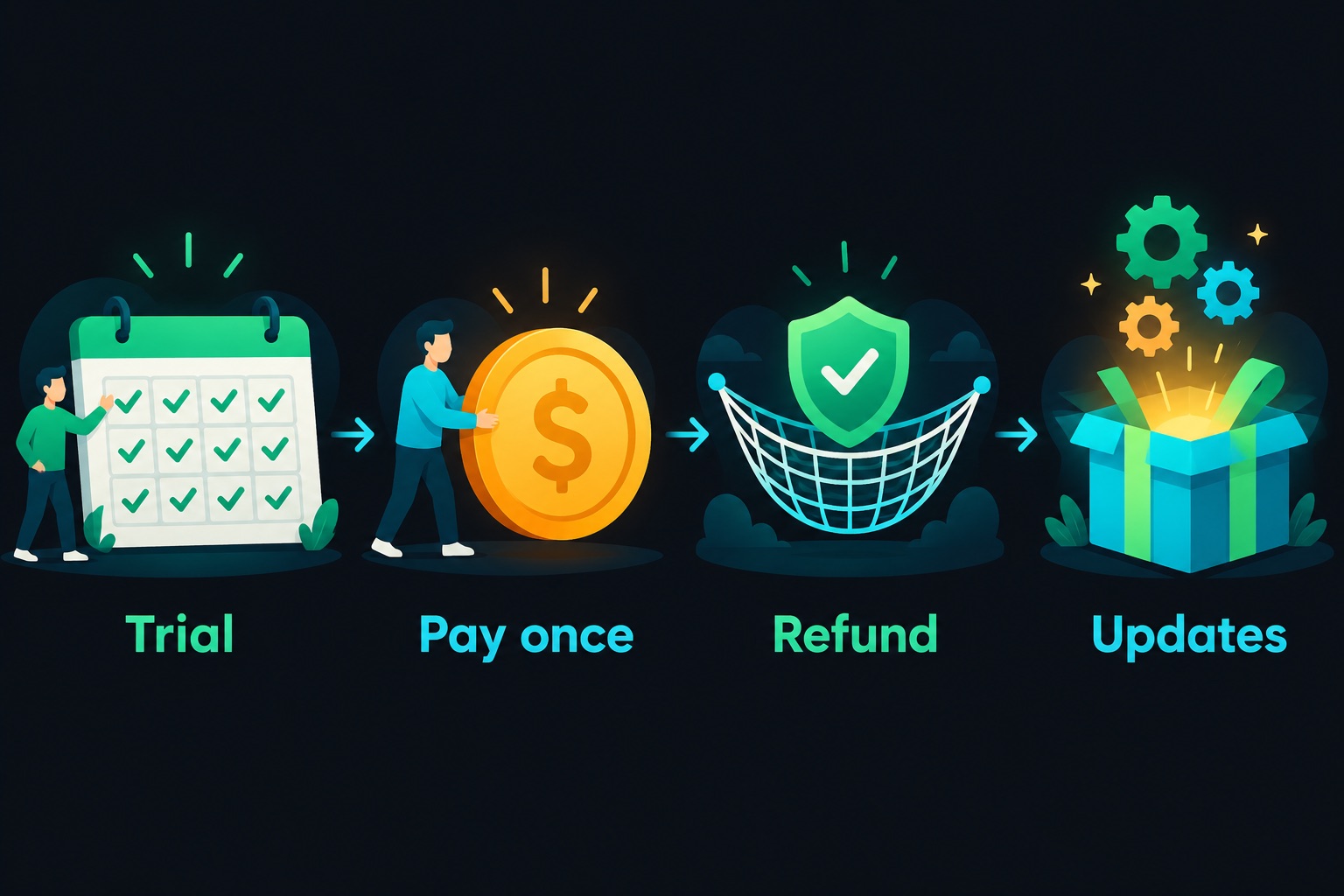
| Item | What you get |
|---|---|
| Price | $24.99 one-time ("Pay once. Use forever.") |
| Launch price | $19.99 on Show HN (July 2026) |
| Updates | All future updates included |
| License | One personal license for a single person |
| Trial | 30 days, no credit card |
| Refund | 14 days, no questions asked; license is deactivated and the app falls back to trial mode |
| Checkout | Lemon Squeezy (a checkout service for software sellers) |
Free vs paid: the trial is the free tier
There's no feature-limited free version. You get the full app for 30 days, then you pay or stop.
That choice fits a file manager. The value shows up in habits, like jumping to a folder by typing three letters. A week isn't enough to build that habit. Thirty days is.
The trial also has a privacy twist. According to the launch post, the app's only network call is a version check, and the trial version skips even that. The trial end date is checked locally, on the Mac, by trusting the system date.
In plain words, a determined user could extend the trial. The developer chose that on purpose and said so. It trades a little lost revenue for zero tracking, which suits the audience.
Trial and refund terms
A 30-day trial plus a 14-day refund is generous. Most buyers will know by day 30 whether they like it. The refund mostly removes fear at checkout.
When someone refunds, the license is deactivated but the app keeps working in trial mode. That's a gentle exit. It avoids an angry "you deleted my app" moment.
What the price signals
Under $25 is an impulse buy for a daily tool. Mac power users already pay for utilities. At this price, the question is "is this better than Finder?" rather than "can I afford it?"
Raising the price after launch signals confidence. Launching at $19.99 rewarded early buyers from Hacker News. Moving to $24.99 later suggests the developer saw enough demand to charge more. It also gives early buyers a quiet win.
"All future updates included" is a promise with a cost. One HN commenter argued that one-time pricing rarely sustains a solo business long term. Others pointed to Mac file managers that have lasted for decades on paid licenses. Both can be true. The model works when the app is small, runs locally and needs no servers. WhimFiles fits that: it's about 9 MB and calls no backend except the version check.
Native, not Electron, is part of the pitch. Electron apps bundle a whole web browser, so they're often large. The Show HN title leads with "9 MB, no Electron." For this buyer, small and native justifies paying at all.
The AI question is now part of pricing. One commenter asked for a public AI statement. Others worried about giving filesystem access to an app from an anonymous developer. If you build with AI, expect trust questions to affect conversion. Being upfront, as whimbyte was in the post, helps.
What to copy
- Charge once only if your running costs are near zero. No servers means no monthly bill to cover.
- Launch lower, then raise the price. Reward early adopters and test demand.
- Make the trial the free tier. Full features, long enough to form a habit.
- Pair the trial with a short refund window. It removes checkout fear.
- Say how you built it. Mention AI and privacy choices before someone asks.
If you vibe-code this
WhimFiles is a desktop app that moves, copies and deletes people's files. For this type of app, mistakes cost real data. These checks are general, not a comment on WhimFiles. In fact, the developer describes doing the first one: copies go to a temp file and are atomically renamed into place.
- Write to a temp file, then rename. A rename in the same folder is atomic (it either fully happens or doesn't), so a crash never leaves a half-written file.
- Move to Trash instead of deleting. Let users undo.
- Handle cross-volume moves carefully. A move to another drive is really copy, verify, then delete.
- Never ship payment or license secrets in the app. Anything in the binary can be extracted. See environment variables security.
- Vet every package your AI agent adds. See supply-chain security.
A safe copy in C#:
// Copy to a temp file in the destination folder, then rename into place.
var dir = Path.GetDirectoryName(dest)!;
var tmp = Path.Combine(dir, $".{Path.GetFileName(dest)}.{Guid.NewGuid():N}.tmp");
try
{
    File.Copy(src, tmp, overwrite: false);
    File.Move(tmp, dest, overwrite: false); // throws if dest already exists
}
finally
{
    if (File.Exists(tmp)) File.Delete(tmp); // clean up if anything failed
}
Building a desktop tool with an AI agent and want a second opinion before launch? Email [email protected] for a security audit.
Key takeaway
WhimFiles shows a clean one-time model: a small native app, no servers, a full 30-day trial, a 14-day refund and a price that rose after launch. It won't suit an app with AI or hosting costs. For a local utility built with Claude Code, it's a pricing plan you can copy.
More case studies: Vibe-coded apps making money · Before you launch: Vibe coding security guide
Sources
- Show HN: "Fast, native Mac file manager (filters, fuzzy find, 9 MB, no Electron)" (Jul 7, 2026): https://news.ycombinator.com/item?id=48814952
- WhimFiles homepage and pricing: https://whimfiles.com
- WhimFiles refund policy: https://whimfiles.com/refund
- WhimFiles terms: https://whimfiles.com/terms