Subscribr Makes $30K/mo: Built with Claude Code (Case Study)
October 11, 2026 · 1391 words
| Item | Detail |
|---|---|
| What it is | AI tool that helps YouTube creators find video ideas, write scripts, make thumbnails and now edit videos |
| Builder | Developer (Gil Hildebrand, 25 years of coding, ex-CTO of Squidoo; a co-founder joined later for sales) |
| AI tool | Claude Code: "about 90%" of his code, in his own words (spelled "cloud code" in the transcript) |
| Stack | Laravel (PHP) with Livewire and Horizon, one DigitalOcean server, several AI model providers |
| Time to launch | Pre-sold with a promised 2-month build; launched April 2024 |
| Revenue | Typically about $30K/month; $700K+ in sales over the past year (self-reported, Starter Story, Dec 2025) |
| Source | Starter Story · Indie Hackers, Aug 27, 2025 |

Subscribr is an AI tool for YouTube creators. Its founder, Gil Hildebrand, says revenue is typically about $30,000 a month, with over $700,000 in sales in the past year. Those figures come from his Starter Story interview (December 2025) and are self-reported.
He made his first $20,000 before the product existed. Then he wrote most of the code with Claude Code.
The one point to take away: he got paid before he built, so the AI coding only had to make a product people had already bought.
The problem: YouTube scripts are slow
Making a good YouTube video starts long before you hit record. You need an idea that will get clicks, a script that holds attention and a thumbnail people want to tap.
Subscribr started as an AI script writer for that job. It now covers the whole chain. It finds "outlier" ideas (videos doing far better than a channel's usual), writes scripts, makes thumbnails and turns a script into an edited video. It also connects to AI agents like Claude and Cursor through MCP, a standard way to give an AI assistant access to outside tools and data.
The homepage says it is "trusted by 5,000+ creators." That is the company's own claim.
How it was built
Gil is not a first-time coder. He started coding at 15, was CTO of the publishing site Squidoo, and later co-founded a funded crypto startup. This is a developer using AI to move faster, not a "never coded before" story.
In the Starter Story interview he says about 90% of his code is now written with Claude Code. Claude Code is an AI agent that reads your project and writes and edits code from your terminal. The auto-transcript spells it "cloud code", which almost certainly means Claude Code.
The stack is deliberately boring:
- Laravel. A PHP web framework that ships with login, database tools and email built in.
- Livewire. A Laravel add-on that makes pages update live, without writing a separate JavaScript front end.
- Horizon. Laravel's dashboard for background jobs, the slow tasks (like generating a script) that run after the page loads.
- One DigitalOcean droplet. A single rented server hosts the whole product.
- Several AI model providers for the writing and image work. He doesn't name them.
What's not disclosed: which parts Claude Code wrote, and whether the first 2024 version used it. Claude Code came out after Subscribr launched, so the 90% figure describes how he builds now.
How it makes money
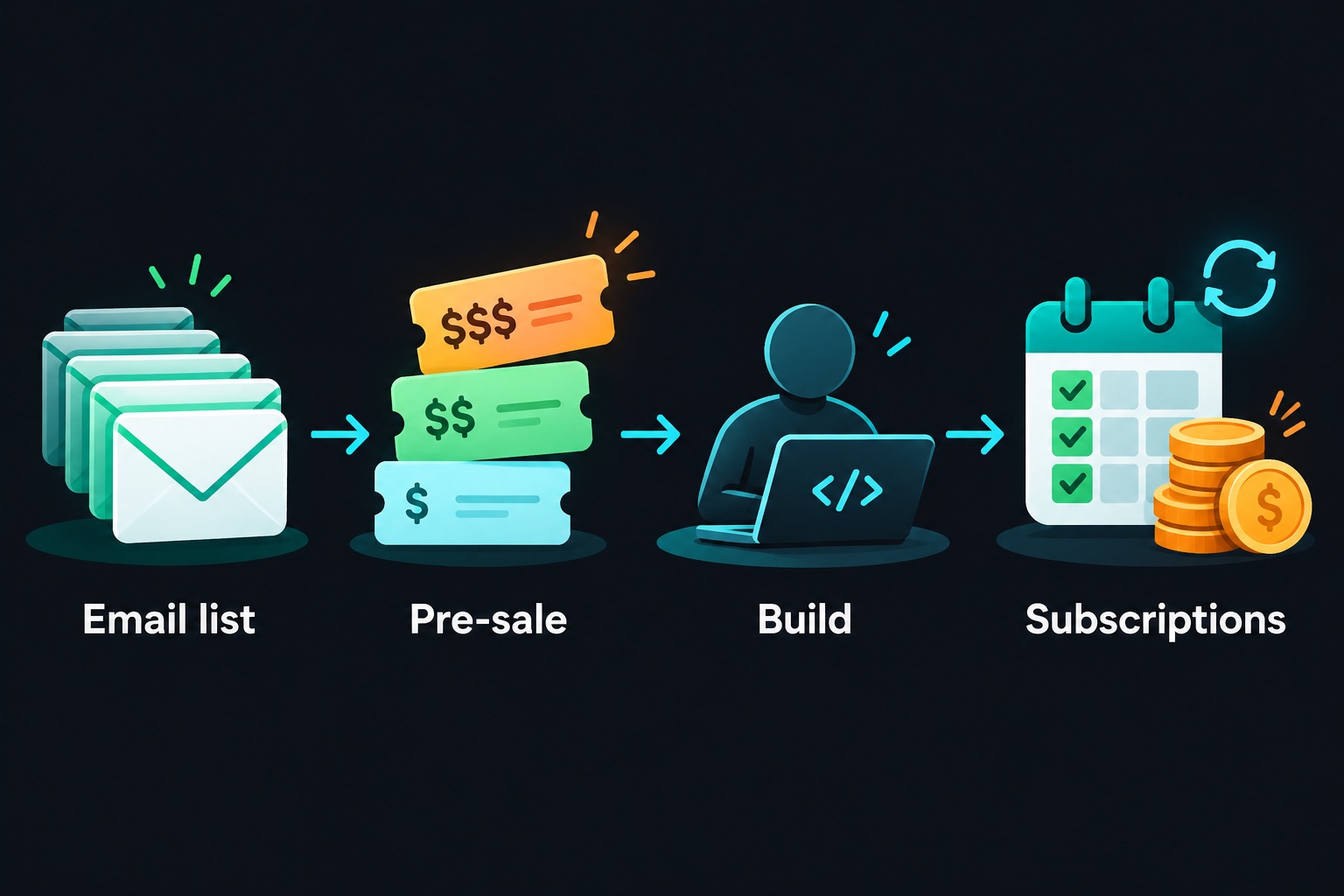
Gil's real trick came before any code. He sold 50 lifetime licenses to his email list. The first 10 were cheapest, and the price went up every 10 sales. All 50 sold in a few days, for over $20,000.
The pre-sale page promised the product within two months. Buyers could get a refund if he missed the deadline or they were unhappy. He says only a few asked.
After launch he switched to monthly plans. In August 2025, plans started at $49 a month. The pricing page has since moved up:
| Plan | Price | What you get |
|---|---|---|
| Free | $0 | Idea research only, no card needed |
| Growth | $99/mo | Up to 8 finished videos, 60 script credits, 150 thumbnails |
| Pro | $249/mo | Up to 23 videos, 180 script credits, 500 thumbnails |
| Max | $499/mo | Up to 52 videos, 300 script credits, unlimited channels |
Annual billing gives two months free. Extra video credits are sold as top-ups from $20.
Costs are real. He says he spends about $3,500 a month on AI compute, about $2,000 on ads and about $1,500 on other services. Even so, he says the business was profitable from day one.
In his Indie Hackers interview, Gil described the early curve in one line:
"It took 100 days after launch to start hitting $10k months." — Gil Hildebrand, Indie Hackers
That same interview listed revenue above $62K a month in August 2025. He later called about $30K a "typical" month, so revenue clearly swings.
First users: an audience built from zero
Gil opened a brand-new X account with zero followers. He followed YouTube creators and ran weekly giveaways to get noticed. He also shared small free tools and industry reports.
That built an email list of about 1,000 people. He asked them what they needed, then sold the pre-sale to the same list.
Later channels, per the founder:
- Programmatic SEO. Pages generated from a template and data, one per search term. He says they bring over 30,000 views a month from Google.
- An affiliate program, plus Google and Meta ads.
- A co-founder with a YouTube channel who handles sales and teaching customers. Gil says revenue jumped 50% in their first month working together.
What to copy
- Sell before you build. A pre-sale with a refund promise is a test people pay to take.
- Raise the price as you sell. Rising pre-sale tiers reward early buyers and create urgency.
- Use a stack you already know. Claude Code is faster in a framework you can read and check.
- Go where your buyers already are. YouTube creators live on X and search Google, so he did too.
- Track AI costs from day one. $3,500 a month on model calls is the price of the product working.
If you vibe-code this
This app type is an AI content SaaS with credits, subscriptions and API or MCP access for agents. Here are the checks I'd run on any app like it:
- Spend credits on the server, in one step. Never trust a credit count from the browser.
- Rate-limit the generate endpoints. Every call costs you money. See API rate limiting.
- Verify payment webhooks before you grant a plan. See Stripe webhook security.
- Scope API and MCP keys to one account. An agent key should never read another user's channel data. See IDOR and authorization and MCP security tools.
- Treat scraped video titles as untrusted input to your AI prompts. See prompt injection.
A Laravel query that spends credits atomically, so two fast clicks can't both pass:
$spent = DB::table('users')
    ->where('id', $request->user()->id)
    ->where('credits', '>=', $cost)
    ->decrement('credits', $cost);

if ($spent === 0) {
    abort(402, 'Not enough credits');
}
Use the logged-in user's ID, never a user ID from the request body.
Building a paid AI tool with Claude Code? Email [email protected] for a vibe-code security audit.
Key takeaway
Subscribr was profitable before it had a product, because Gil sold it first. Claude Code now writes most of his code, but the $30K months came from the audience, the pre-sale and the price.
More case studies: Vibe-coded apps making money · Security basics: Vibe coding security guide