Open-Source RAG Frameworks: 6 Best Tools to Build Retrieval-Augmented Generation Apps in 2026
July 13, 2026 · 1882 words
Open-source RAG frameworks are how vibe coders turn a pile of PDFs, docs, and database rows into an app that answers questions with real citations instead of hallucinations. This roundup covers the six best open-source RAG frameworks in 2026 — from full drag-and-drop platforms to a single pip install library — compared by GitHub stars, license, language, and the exact job each one does best, so you can pick the right retrieval layer without reading a dozen READMEs. Every repo below was verified directly on GitHub, and star counts are approximate as of July 2026.
Retrieval-augmented generation (RAG) is the pattern behind almost every "chat with your data" feature: you index your content into a vector (and often keyword) store, retrieve the most relevant chunks at query time, and stuff them into the model's context so the answer is grounded in your sources. The catch is that "add RAG" hides a stack of decisions — chunking, embeddings, hybrid search, reranking, evaluation — and each tool below draws the line between "you configure it" and "it's handled for you" in a different place.
The Open-Source RAG Frameworks at a Glance
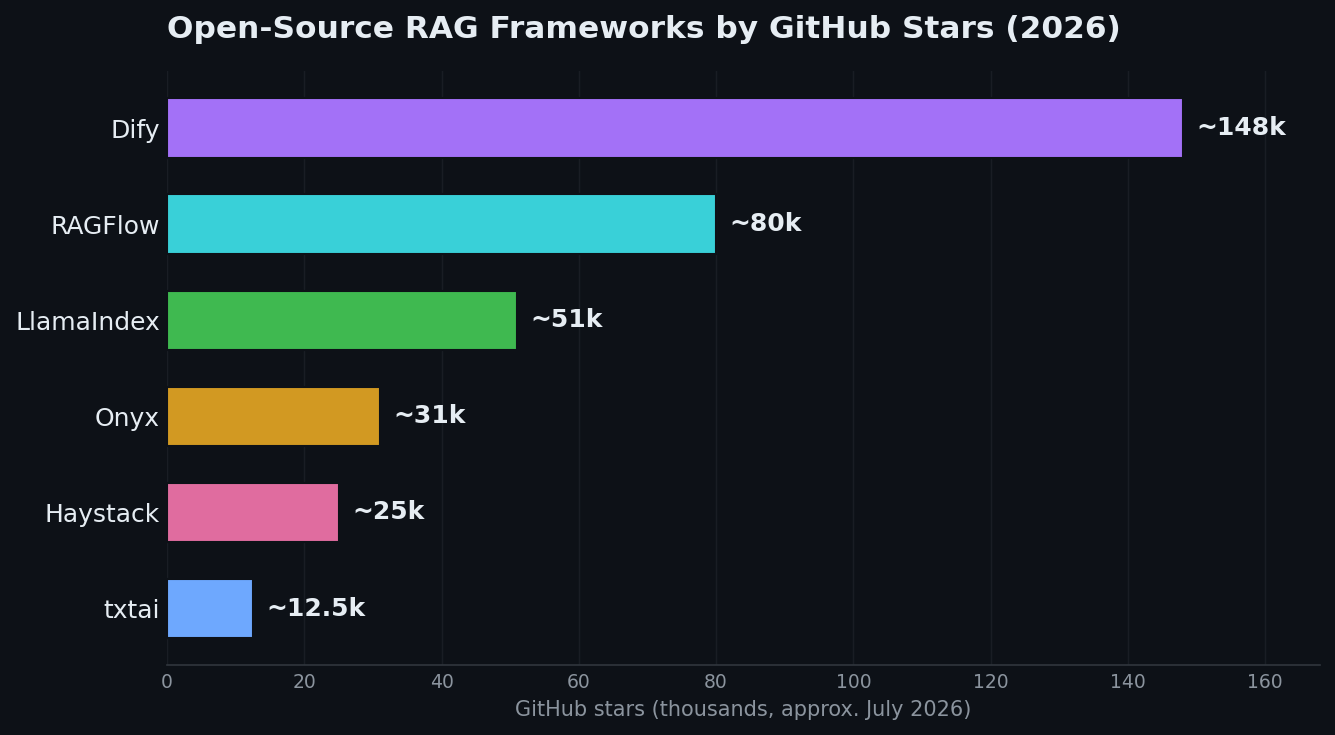
Here's the full lineup, sorted by GitHub stars. Skim it as a cheat sheet, then jump to whichever section matches how much you want to build yourself.
| Framework | Stars (2026) | Best for | Language | License |
|---|---|---|---|---|
| Dify | ~148k | No-code LLM app + RAG platform | Python / TypeScript | Dify Open Source License (Apache-2.0 based) |
| RAGFlow | ~80k | Deep document understanding on messy files | Python | Apache-2.0 |
| LlamaIndex | ~51k | Code-first data framework for RAG | Python | MIT |
| Onyx | ~31k | Self-hosted "chat with your company docs" | Python / TypeScript | MIT (Community Edition) |
| Haystack | ~25k | Production pipelines with explicit control | Python | Apache-2.0 |
| txtai | ~12.5k | Lightweight, all-in-one embeddings + RAG | Python | Apache-2.0 |
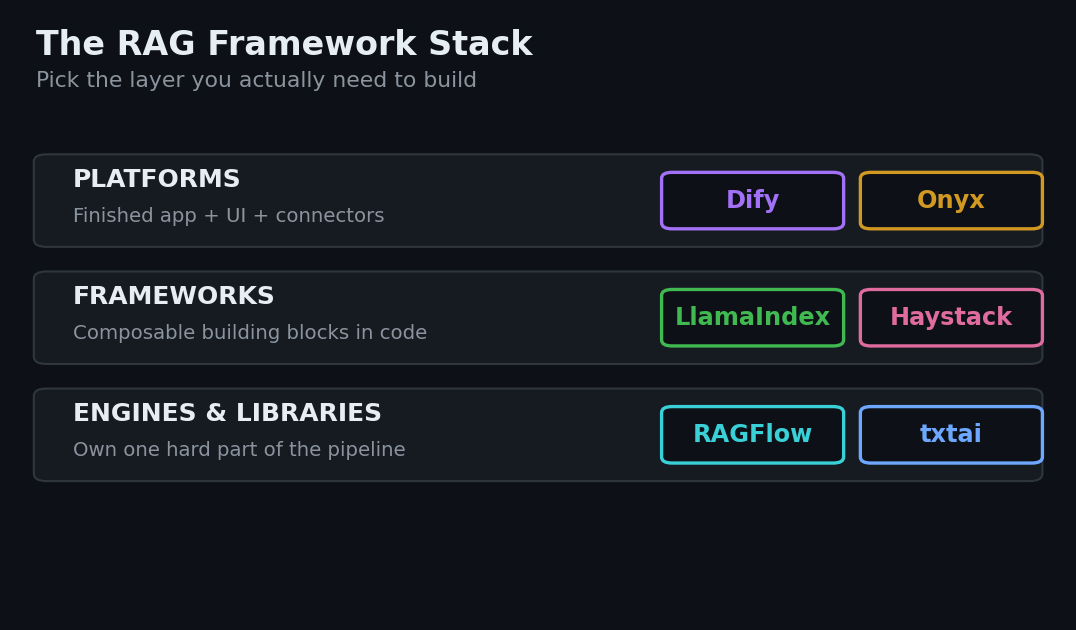
These frameworks fall into three layers. Platforms (Dify, Onyx) hand you a working app with a UI and connectors. Frameworks (LlamaIndex, Haystack) give you composable building blocks you wire together in code. Engines and libraries (RAGFlow, txtai) own a specific hard part — deep document parsing or a self-contained embeddings database. Knowing which layer you want is most of the decision.
1. Dify — a no-code platform for RAG apps
Dify is the most-starred project in this space at roughly 148k stars, making it one of the most popular open-source LLM tools on GitHub, period. It's a production-ready platform for agentic workflow development: a visual builder where you drag nodes to compose prompts, tools, and a built-in knowledge base (RAG) pipeline, then ship the result as a web app or an API. It's licensed under the Dify Open Source License (Apache-2.0 with a couple of commercial-use conditions) and written in Python and TypeScript.
Why it matters to vibe coders: Dify is the fastest way to go from "I have some documents" to a working, hosted RAG chatbot without hand-writing an ingestion pipeline. Upload files, pick an embedding model, and the retrieval, reranking, and citation plumbing is handled behind a UI.
When to use it: you want a real RAG product — with accounts, an admin panel, and an API — more than you want low-level control. Spin it up with Docker:
git clone https://github.com/langgenius/dify.git
cd dify/docker && cp .env.example .env
docker compose up -d
# open http://localhost/install
2. RAGFlow — deep document understanding for messy files
RAGFlow is a leading open-source RAG engine at roughly 80k stars, Apache-2.0, and built in Python. Its differentiator is deep document understanding: instead of naively splitting text, it parses complex, real-world layouts — scanned PDFs, tables, figures, slides — into clean, structured chunks, which is exactly where most homegrown RAG pipelines fall apart. It also fuses classic RAG with agent capabilities for multi-step retrieval, and recent releases (the latest is v0.25.4, May 2026) added more data-source connectors.
Why it matters to vibe coders: garbage chunks in means garbage answers out. If your source material is heavy on tables and PDFs rather than clean Markdown, RAGFlow's parsing does the unglamorous work that determines whether your app actually gives correct answers.
When to use it: your knowledge base is full of formatted documents and retrieval quality is the whole ballgame. Get started with Docker:
git clone https://github.com/infiniflow/ragflow.git
cd ragflow/docker
docker compose -f docker-compose.yml up -d
# then open http://localhost
3. LlamaIndex — the code-first data framework for RAG
LlamaIndex is the go-to data framework for building RAG in Python, at roughly 51k stars and MIT-licensed. It gives you first-class primitives for the whole pipeline — data loaders (LlamaHub has hundreds), node parsers, indexes, retrievers, and query engines — plus higher-level workflow and agent abstractions when a single retrieval step isn't enough. It's the library people reach for when they want to compose RAG in code rather than click through a UI.
Why it matters to vibe coders: it hits the sweet spot between "do everything yourself" and "black box." You get sensible defaults to ship a prototype in a dozen lines, and every layer is swappable when you need to tune chunking, embeddings, or reranking. Its MIT license also makes it the easiest to embed in a commercial product.
When to use it: you're building the RAG layer inside your own Python app and want maximum flexibility. Install and index in minutes:
pip install llama-index
# set OPENAI_API_KEY, then:
# from llama_index.core import VectorStoreIndex, SimpleDirectoryReader
# docs = SimpleDirectoryReader("data").load_data()
# index = VectorStoreIndex.from_documents(docs)
# print(index.as_query_engine().query("What is this about?"))
If you'd rather point LlamaIndex at a model on your own machine than a cloud API, pair it with a runner from our guide to running LLMs locally — most speak the OpenAI API that LlamaIndex expects.
4. Onyx — self-hosted chat over your company's knowledge
Onyx (formerly Danswer) is an open-source AI platform at roughly 31k stars, with its Community Edition under the MIT license and a stack of Python and TypeScript. It's the "chat with your company docs" application in a box: 50+ indexing connectors (Google Drive, Slack, Confluence, GitHub, and more), agentic RAG with hybrid search, web search, and a polished chat UI you can self-host with one command. Development is brisk — the latest release, v4.3.4, shipped in July 2026.
Why it matters to vibe coders: when the goal is an internal knowledge assistant rather than a library to build on, Onyx is a finished product you own. The connectors alone save weeks of writing ingestion glue for every SaaS your team uses.
When to use it: you want a deployable, connector-rich RAG assistant for a team, not a framework. Deploy it in one line:
curl -fsSL https://onyx.app/install_onyx.sh | bash
5. Haystack — production RAG pipelines with explicit control
Haystack, from deepset, is an open-source AI orchestration framework at roughly 25k stars, Apache-2.0, and Python. Its philosophy is explicit, modular pipelines: you compose typed components — retrievers, rankers, prompt builders, generators — into a graph with branches, loops, and conditional routing, so exactly how context is retrieved and assembled is transparent and testable. It's model- and vendor-agnostic and is used in production by teams at organizations including Airbus and Netflix.
Why it matters to vibe coders: when a naive RAG prototype needs to become something you can debug, evaluate, and trust, Haystack's traceable pipelines are built for that transition. Nothing is hidden, which is precisely what you want when an answer is wrong and you need to find out why.
When to use it: you're moving from a demo to a production system and want observability and control over every step. Install and build:
pip install haystack-ai
# compose a Pipeline of components (retriever -> prompt builder -> generator)
# see https://haystack.deepset.ai/overview/quick-start
6. txtai — an all-in-one embeddings database and RAG
txtai, from NeuML, is the most self-contained option at roughly 12.5k stars, Apache-2.0, and pure Python. It's an all-in-one embeddings database — vector indexes (sparse and dense), graph networks, and a relational store in one package — with pipelines, workflows, agents, and RAG built on top. You can be running semantic search in a couple of lines and add LLM orchestration without pulling in a heavy stack.
Why it matters to vibe coders: it's the low-footprint choice. When you want RAG and semantic search embedded directly in a small app — or running fully local with no external vector database to operate — txtai keeps the whole thing in one dependency.
When to use it: you want a lightweight, batteries-included embeddings + RAG layer without standing up separate services. Get started:
pip install txtai
# import txtai
# embeddings = txtai.Embeddings()
# embeddings.index(["RAG grounds answers in your data"])
# print(embeddings.search("what does RAG do?", 1))
How to Choose the Right Open-Source RAG Framework
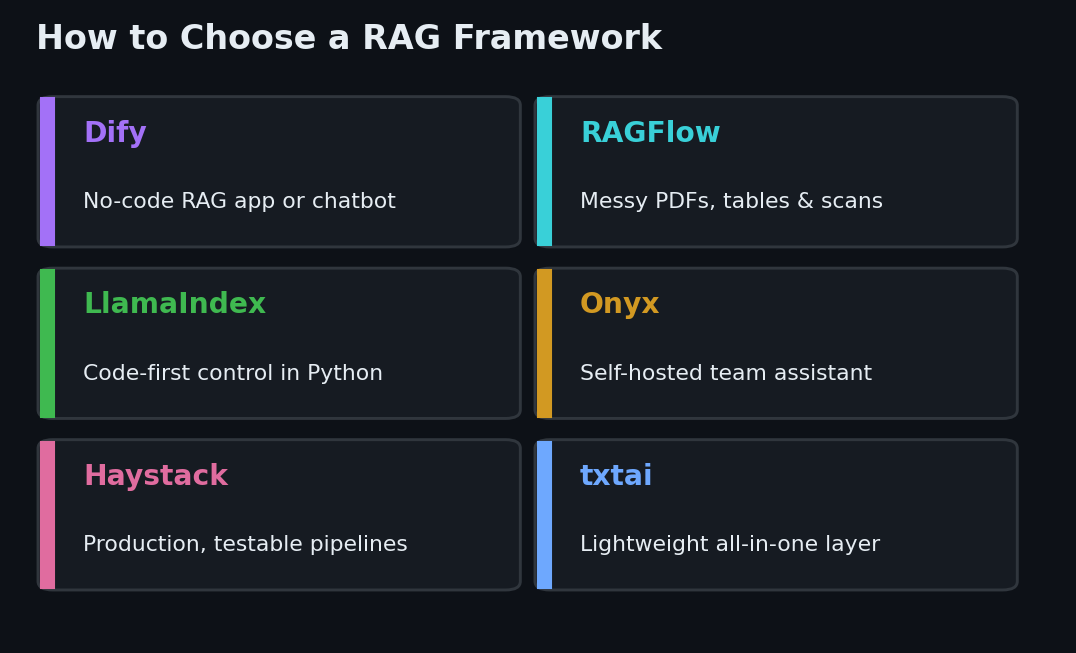
There's no single winner — the right pick depends on how much you want to build versus how much you want handed to you. Use this quick decision guide:
- You want a finished RAG app or chatbot, no code: start with Dify.
- Your documents are messy PDFs, tables, and scans: run them through RAGFlow.
- You're building RAG in your own Python app and want full control: use LlamaIndex.
- You want a self-hosted assistant over your team's tools and docs: deploy Onyx.
- You're taking a prototype to production and need testable pipelines: choose Haystack.
- You want a tiny, all-in-one, run-anywhere embeddings + RAG layer: pick txtai.
A common, powerful setup is a framework for the retrieval logic (LlamaIndex or Haystack), a strong parser for tough files (RAGFlow), and a local model behind it — grounded answers, your data, your infrastructure. To let your RAG app pull in live tools and data sources as well, see our roundup of the best MCP servers for vibe coding.
Key Takeaway
Open-source RAG frameworks in 2026 span the full range from no-code platform to single-import library, and the smart move is to match the tool to the layer you actually need. Dify ships a RAG app the fastest, RAGFlow wins on hard documents, LlamaIndex is the flexible code-first framework, Onyx is a connector-rich team assistant, Haystack brings production-grade pipelines, and txtai is the featherweight all-in-one. Pick the layer that fits, confirm the license works for your use case, and you can ship grounded, cite-your-sources AI on top of your own data.
Star counts, licenses, and release details are approximate and were verified on GitHub in July 2026. This space moves fast — check each repo's latest release and license before you build on it.