6 Open-Source Firebase Alternatives That Give Vibe Coders a Backend They Own in 2026
July 11, 2026 · 1829 words
Open-source Firebase alternatives give vibe coders an auth-plus-database-plus-storage backend they can self-host, read, and extend — instead of renting a closed platform and hoping the pricing never changes. This roundup covers the six best open-source Firebase alternatives on GitHub in 2026, compared by stars, license, language, and the exact job each one is best at, so you can pick a backend without wading through a dozen docs sites. Every repo below was verified directly on GitHub, and star counts are approximate as of July 2026.
When you vibe code a SaaS, the frontend is the fun part and the backend is where projects stall: users, sessions, a database, file uploads, realtime, and an API to glue it together. A backend-as-a-service (BaaS) hands you all of that on day one. The open-source ones go further — you can run them on your own box, point your AI agent at a real schema, and never get locked into per-seat cloud pricing. One honest caveat up front: two entries here (Directus and Convex) are source-available, not strictly OSI open source, and we flag exactly what that means below.
The Open-Source Firebase Alternatives at a Glance
Here's the full lineup, sorted by GitHub stars. Use it as a cheat sheet, then jump to the section that fits your stack.
| Repo | Stars (Jul 2026) | Best for | Language | License |
|---|---|---|---|---|
| Supabase | ~102k | The complete Postgres BaaS | TypeScript | Apache-2.0 |
| PocketBase | ~58k | Single-file backend for solo builds | Go | MIT |
| Appwrite | ~56k | All-in-one self-hosted platform | PHP / TypeScript | BSD-3-Clause |
| Directus | ~36k | Turning an existing SQL DB into an API | TypeScript / Vue | MSCL 1.0 (source-available) |
| Convex | ~12k | Reactive, TypeScript-native, AI-friendly | Rust / TypeScript | FSL-1.1-Apache-2.0 (source-available) |
| Nhost | ~9k | Postgres backend with GraphQL | Go / TypeScript | MIT |
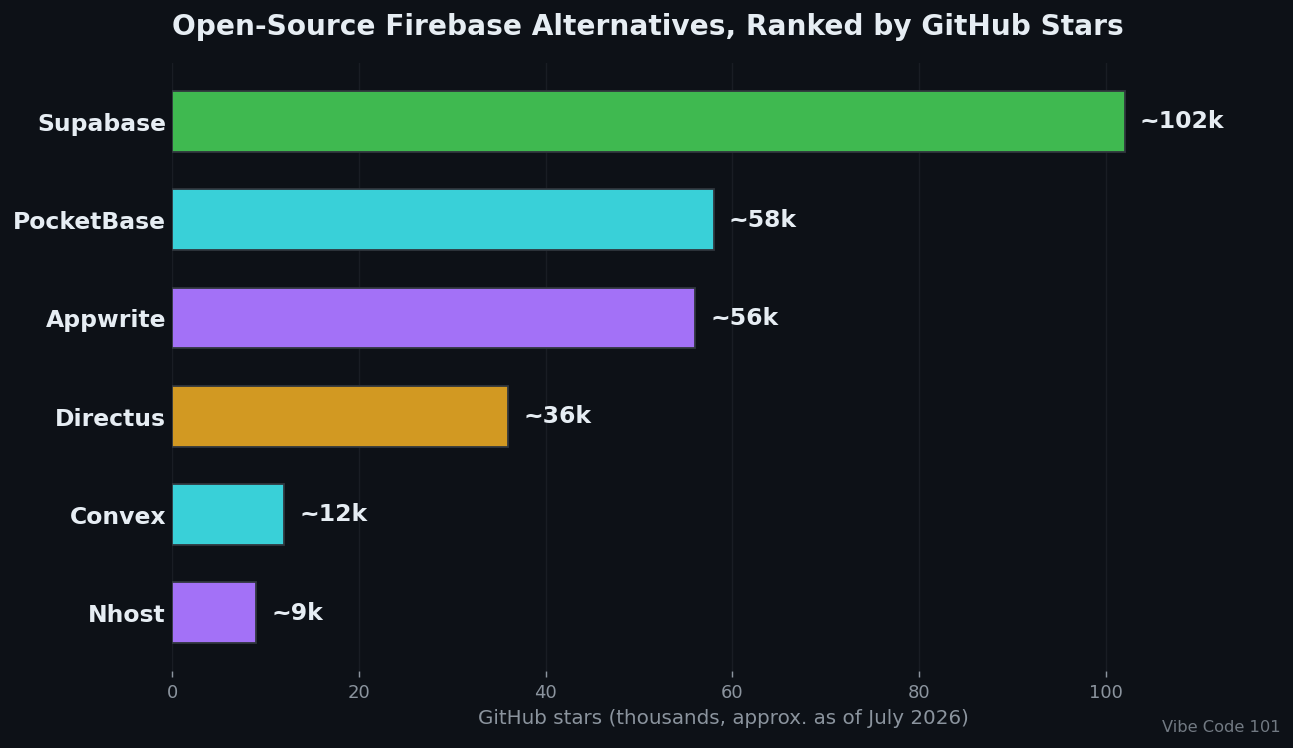
A quick mental model: Supabase, Appwrite, PocketBase, and Nhost are batteries-included backends you deploy as your app's core. Directus sits on top of a database you already have. Convex rethinks the backend as reactive TypeScript functions. Most vibe coders will pick one as their foundation and never look back.
1. Supabase — the complete open-source Firebase alternative
Supabase is the most-starred entry in this space at roughly 102k stars, Apache-2.0 licensed, and the closest thing to a drop-in Firebase replacement. It gives you a dedicated Postgres database with auto-generated REST and GraphQL APIs, realtime subscriptions, row-level-security auth, file storage, edge functions, and a built-in pgvector toolkit for AI embeddings — all behind a polished dashboard.
Why it matters to vibe coders: Postgres is the most AI-legible database there is, so coding agents write correct queries against it out of the box. Supabase also ships first-class client libraries for JavaScript, Flutter, Swift, and Python, and it's the default backend most Next.js and React tutorials assume. You can start on the hosted free tier and self-host later without rewriting your app.
When to use it: you want one mature backend that does auth, database, storage, and vectors, and you're happy in SQL. Spin up a local stack:
npx supabase init
npx supabase start   # full local stack via Docker
If you're pairing this with a frontend, our roundup of Next.js SaaS boilerplates covers templates that wire straight into Supabase.
2. PocketBase — your whole backend in one file
PocketBase is the minimalist's favorite at roughly 58k stars, MIT-licensed, and written in Go. The entire backend — an embedded SQLite database, realtime subscriptions, user management, file storage, and an admin dashboard — ships as a single executable file you can run anywhere. Extend it in JavaScript or use it as a Go framework.
Why it matters to vibe coders: there is no simpler way to stand up a real backend. Download one binary, run ./pocketbase serve, and you have an API, an auth system, and an admin UI in seconds — perfect for a prototype, a side project, or an internal tool you'll deploy to a single small VPS. Note it's still pre-1.0 (v0.38 as of May 2026), so backward compatibility isn't guaranteed yet.
When to use it: you're a solo builder who wants zero infrastructure and one deployable artifact. Get started:
# download the binary for your OS from the releases page, then:
./pocketbase serve
# admin UI at http://127.0.0.1:8090/_/
3. Appwrite — the all-in-one self-hosted platform
Appwrite is the batteries-included, self-host-first BaaS at roughly 56k stars and BSD-3-Clause licensed. It bundles auth (with OAuth, MFA, and magic links), databases, storage, serverless Functions across 15 runtimes, multi-channel Messaging (email/SMS/push), realtime, and even integrated web hosting through Sites — installed with a single Docker command.
Why it matters to vibe coders: Appwrite is the closest match to Firebase's "everything in one console" experience, but running on infrastructure you control. Its wide SDK support (Web, React Native, Flutter, Apple, Android, plus nine server languages) makes it a strong pick when your project spans web and mobile.
When to use it: you want a full product-grade backend you self-host from day one, especially for a cross-platform app. Install it:
docker run -it --rm \
  --volume /var/run/docker.sock:/var/run/docker.sock \
  --volume "$(pwd)"/appwrite:/usr/src/code/appwrite:rw \
  --entrypoint="install" \
  appwrite/appwrite:1.9.0
4. Directus — instant API on top of your existing database
Directus takes a different angle at roughly 36k stars: instead of giving you a new database, it wraps any SQL database you already have — Postgres, MySQL, SQLite, MS SQL, MariaDB, OracleDB, and more — with an instant REST and GraphQL API, a visual admin Studio, and granular access control. In 2026 it also ships a native MCP server, so agents like Claude and Cursor can act on your live data under the same permissions as your team.
Why it matters to vibe coders: if your data already lives in a SQL database, Directus turns it into a backend without a migration. The database schema stays the source of truth, and the native MCP integration is a standout for AI-driven workflows. For more on wiring agents into tools like this, see our guide to the best MCP servers for vibe coding.
License note (important): Directus is source-available, not OSI open source. It uses the Monospace Sustainable Core License (MSCL 1.0), which is free for organizations under $5M in annual revenue and 50 employees; larger companies using advanced features need a commercial license. For most indie vibe coders it's effectively free — just know the boundary. Run it:
npx directus-template-cli@latest init
# or: docker compose up  (Postgres + Directus)
5. Convex — a reactive, AI-native backend in TypeScript
Convex reimagines the backend for the TypeScript era, at roughly 12k stars for its open backend. You write your database queries, mutations, and server logic as pure TypeScript functions, and Convex keeps every client automatically in sync with strong consistency — no manual cache invalidation, no realtime plumbing. It's explicitly designed to "make life easy for web app developers, whether human or LLM."
Why it matters to vibe coders: because everything is typed TypeScript end to end, AI agents generate backend code that actually compiles and stays consistent with your frontend. The reactivity means live-updating UIs are the default, not a feature you bolt on. That combination makes Convex one of the most vibe-coding-friendly backends around.
License note: the backend is under FSL-1.1-Apache-2.0 — source-available, with a non-compete clause, that automatically converts to Apache-2.0 two years after each release. Self-hosting for your own product is fully permitted. Start a project:
npm create convex@latest
6. Nhost — the GraphQL-first Postgres backend
Nhost is the pick for GraphQL fans at roughly 9k stars and MIT-licensed. It combines PostgreSQL with Hasura for an instant GraphQL API, plus authentication, file storage, and Node.js serverless functions — a stack you can self-host in full with a single docker-compose file.
Why it matters to vibe coders: it's essentially "Supabase, but GraphQL-first." If you or your agent prefer typed GraphQL queries over REST or SQL, Nhost gives you the same Postgres foundation with a Hasura API layer on top. It's frontend-agnostic, with quickstarts for Next.js, React, Vue, Svelte, and React Native.
When to use it: you want an open-source Postgres backend and you'd rather write GraphQL than SQL. Get started locally:
npm install -D @nhost/cli
nhost init && nhost up
How to Choose Your Open-Source Firebase Alternative
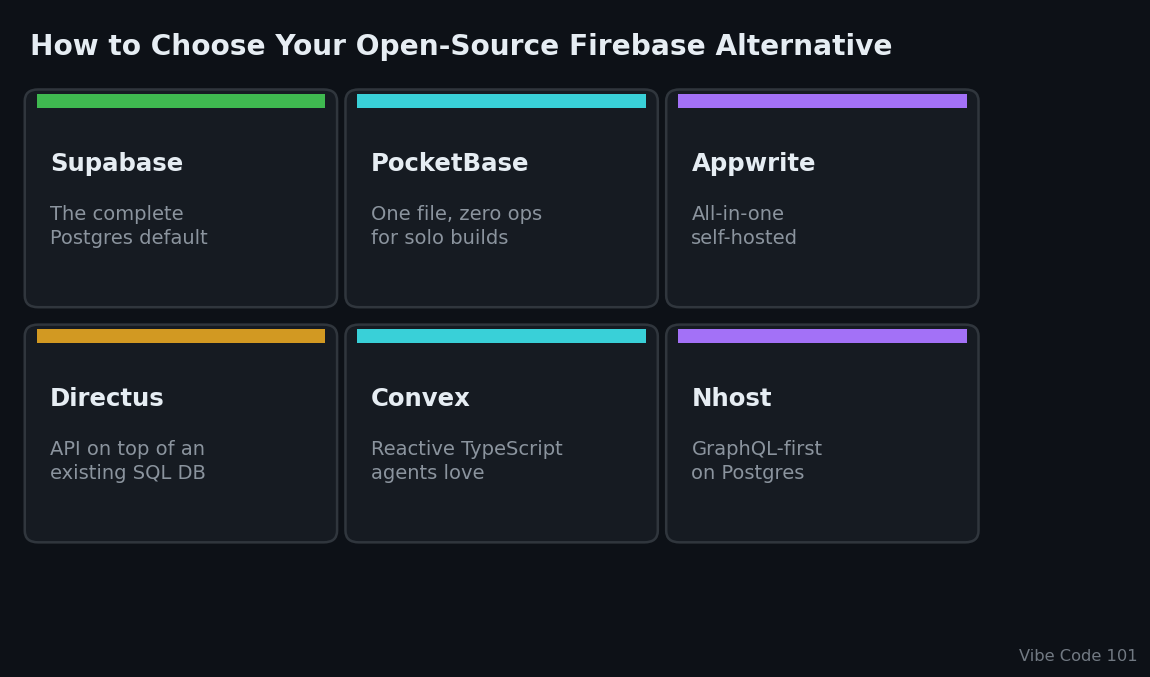
There's no single winner — the right backend depends on your data model, your platform, and how much you want to self-host. Use this quick decision guide:
- You want the complete, mature default: choose Supabase. Postgres, auth, storage, and vectors in one well-supported package.
- You're a solo builder who wants zero ops: run PocketBase. One file, one command, done.
- You need everything self-hosted, especially cross-platform: pick Appwrite.
- Your data already lives in SQL: put Directus in front of it (mind the revenue threshold).
- You want reactive, TypeScript-native, AI-friendly logic: build on Convex.
- You prefer GraphQL on Postgres: go with Nhost.
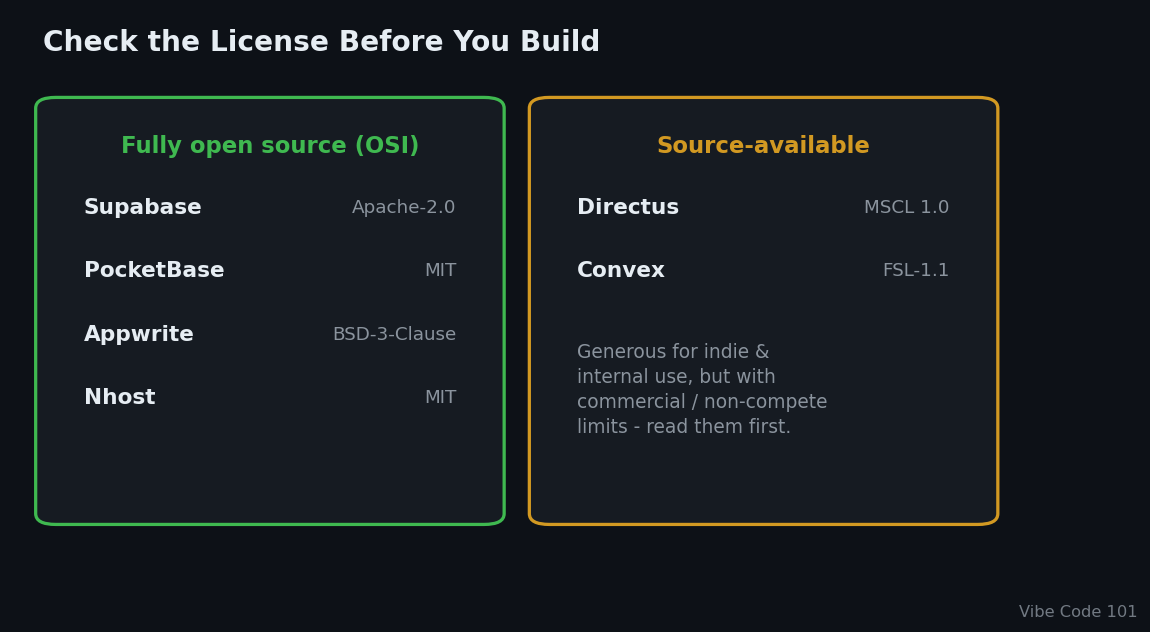
One more filter worth applying: the license. Four of these — Supabase (Apache-2.0), PocketBase (MIT), Appwrite (BSD-3-Clause), and Nhost (MIT) — are unambiguously open source, so you can do essentially anything with them. Directus and Convex are source-available: generous for indie and internal use, but with commercial or non-compete limits worth reading before you build a business on them.
Key Takeaway
The open-source backend ecosystem in 2026 means no vibe coder has to ship on a black box. Supabase is the complete Postgres default, PocketBase is the one-file wonder, Appwrite is the all-in-one self-host, Directus turns an existing database into an API, Convex brings reactive TypeScript logic that agents love, and Nhost delivers a GraphQL-first Postgres stack. Pick the one that matches your data and your platform, confirm the license fits your plans, and you get the speed of vibe coding on a backend you actually own. Once your backend is live, the fastest way to fill it with a working app is good prompting — see our guide on how to prompt for vibe coding.
Star counts, licenses, and project details are approximate and were verified on GitHub in July 2026. This space moves fast — check each repo's latest release and license before you build on it.