Vibe Coding Security: 6 Free Tools to Catch Leaked API Keys Before You Ship (2026)
July 13, 2026 · 1702 words
Vibe coding security starts with one boring-but-critical habit: making sure you never ship a secret. If you've built an app with AI — wiring up OpenAI, Stripe, or Supabase by just asking for it — there's a real chance an API key is sitting in your code where anyone can find it. This guide shows you six free, open-source tools that scan your project and catch leaked keys and secrets before you push them live. No security background needed; every tool below is a copy-paste command away.
Here's why this matters. In early 2026, a scan of 20,052 launched apps (many of them AI-built) found that 11% were leaking their Supabase keys — including the powerful service_role key that hands an attacker full access to your database. The finding was discussed on Hacker News, where even Supabase's CEO joined in to explain the guardrails they've added. A leaked key isn't a hypothetical: people have woken up to five-figure cloud bills and emptied databases. The good news is that catching secrets is one of the easiest security wins there is, and secure vibe coding mostly comes down to running the right scanner.
What counts as a "secret" (and why AI code leaks them)
A secret is any credential that proves you are you: an API key, a database password, an access token, a private key. AI coding assistants are fast and helpful, but when you say "connect this to OpenAI," they'll often paste your key straight into a file — sometimes into frontend code that ships to every visitor's browser. Commit that to GitHub and it's public forever, even if you delete it later (the git history keeps a copy).
The fix is a secret scanner — a tool that reads your code and flags anything that looks like a credential before it leaves your machine. Below are the six best free ones, all verified as active on GitHub in July 2026.
The Vibe Coding Security Tools at a Glance
| Tool | Stars (2026) | Best for | Language | License |
|---|---|---|---|---|
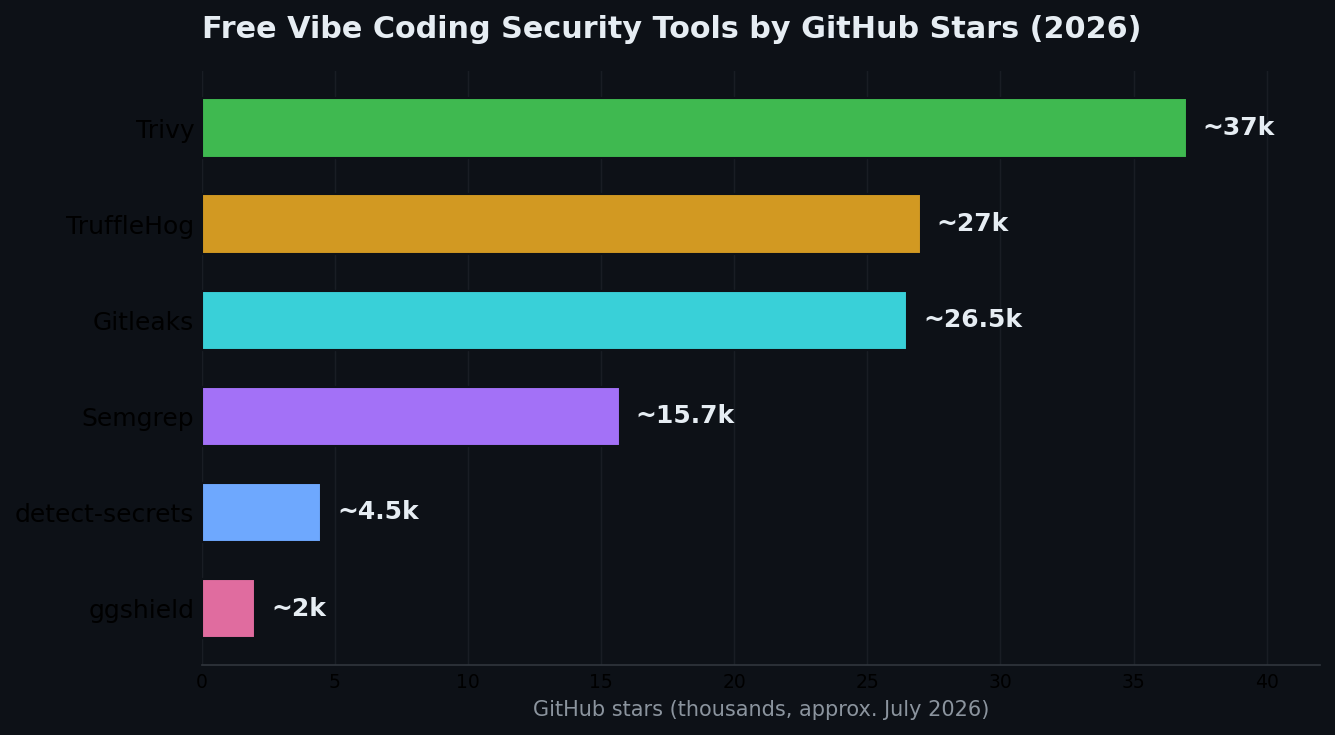
| Trivy | ~37k | All-in-one: secrets + misconfigs + vulnerabilities | Go | Apache-2.0 |
| TruffleHog | ~27k | Confirming a leaked key is actually live | Go | AGPL-3.0 |
| Gitleaks | ~26.5k | Fast pre-commit blocking of secrets | Go | MIT |
| Semgrep | ~15.7k | Finding insecure code patterns, not just keys | OCaml / Python | LGPL-2.1 |
| detect-secrets | ~4.5k | Cleaning up a repo that already has secrets | Python | Apache-2.0 |
| ggshield | ~2k | Catching secrets from your AI assistant in real time | Python | MIT |
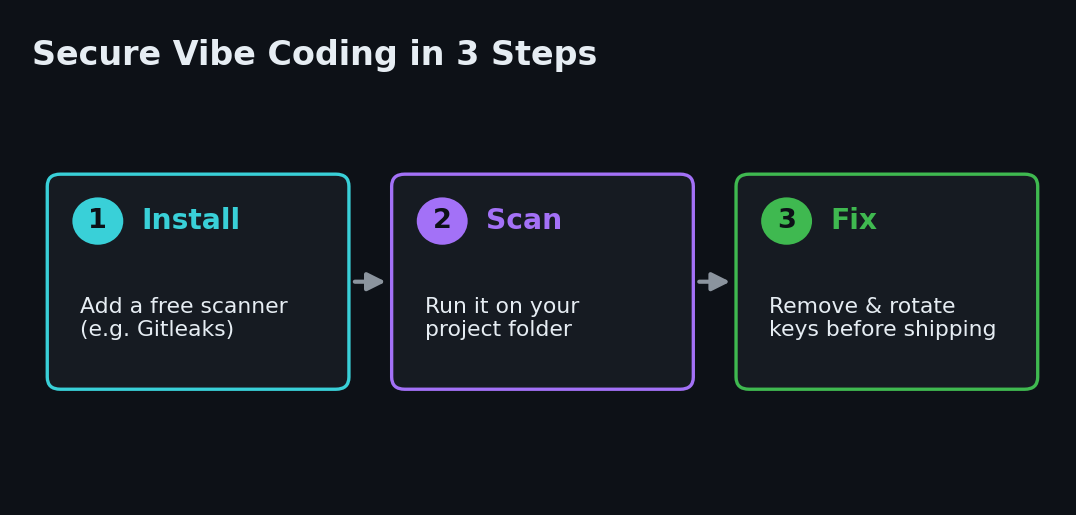
The whole workflow is just three steps: install a scanner, run it on your project, and fix what it finds before you ship. You don't need to understand every rule — the tool does the reading for you.
1. Gitleaks — the easiest place to start
Gitleaks is the friendliest on-ramp to secret scanning, at roughly 26.5k stars, MIT-licensed, and written in Go. It scans your code and your entire git history against 150+ built-in patterns (AWS keys, GitHub tokens, database URLs, and more) and tells you exactly which file and line the secret is on.
Why it matters for vibe coders: it's fast, needs zero configuration to start, and can run automatically every time you commit — so a secret gets blocked before it ever reaches GitHub. That "catch it at the door" behavior is the single highest-value habit in secure vibe coding.
Try it (macOS example — scans the folder you're in):
brew install gitleaks
gitleaks dir -v .
If it finds nothing, you're clean. If it flags something, that's a key to remove and rotate.
2. TruffleHog — confirms whether a leaked key is still dangerous
TruffleHog has roughly 27k stars and one killer feature: verification. It doesn't just guess that a string looks like a key — it can safely test the key against the real service to see if it's still active. That means less noise and a clear "this one is genuinely live, fix it now" signal. Note its license is AGPL-3.0, which is fine for scanning your own code but worth knowing if you plan to bundle it into a product.
Why it matters for vibe coders: when a scanner flags ten possible secrets, you want to know which ones are actually loaded weapons. TruffleHog tells you.
Try it with Docker (no install needed) on the current folder:
docker run --rm -it -v "$PWD:/pwd" trufflesecurity/trufflehog:latest filesystem /pwd
3. ggshield — catches secrets straight from your AI assistant
ggshield, by GitGuardian, is a 2k-star, MIT-licensed CLI that detects 500+ types of secrets. What makes it especially relevant in 2026: it can scan the interactions between you and your AI coding assistant in real time, blocking a secret before the tool even writes it to disk. It officially supports Cursor, Claude Code, Copilot Chat, and Codex.
Why it matters for vibe coders: this is the most "meets you where you are" option. If your whole workflow is chatting with an AI to build features, ggshield plugs into that exact moment. It uses a free GitGuardian account for its detection rules.
Try it:
pipx install ggshield
ggshield auth login
ggshield secret scan path -r .
4. detect-secrets — for a project that already has secrets in it
detect-secrets, from Yelp, is a 4.5k-star, Apache-2.0 Python tool built for a very common situation: you've already been vibe coding for a while and you're scared of what's buried in the repo. Instead of drowning you in alerts, it creates a baseline — a snapshot of what's there today — so you can stop new secrets from getting added while you clean up the old ones at your own pace. (Its last tagged release was 2024, but it remains a widely used, stable standard.)
Why it matters for vibe coders: it turns an overwhelming mess into a manageable checklist. You're not expected to fix everything at once — just to stop the bleeding.
Try it:
pip install detect-secrets
detect-secrets scan > .secrets.baseline
5. Semgrep — finds insecure code, not just leaked keys
Semgrep has roughly 15.7k stars and looks one level deeper than a secret scanner. It's a SAST tool — think of it as a spell-checker for security bugs — that spots insecure patterns in your code, like missing authentication, unsafe database queries, or the exact kind of "no access rules on this table" mistake behind those leaked-Supabase-key headlines. It ships with thousands of ready-made rules, including ones mapped to the OWASP Top 10, and runs locally (your code isn't uploaded). It's licensed under LGPL-2.1.
Why it matters for vibe coders: a leaked key is one risk; insecure logic is another. AI-generated code often skips the boring safety checks, and Semgrep flags those gaps in plain language.
Try it:
pip install semgrep
semgrep scan --config auto
6. Trivy — one scanner for almost everything
Trivy, from Aqua Security, is the most-starred tool here at roughly 37k stars, Apache-2.0, and Go. It's an all-in-one scanner: in a single command it looks for secrets, insecure configuration (like a misconfigured cloud or Docker setup), and known vulnerabilities in the packages your app depends on.
Why it matters for vibe coders: if you only ever run one security tool, a broad scanner catches the widest range of problems for the least effort. Trivy is the closest thing to a "check everything" button.
Try it on your project folder:
brew install trivy
trivy fs --scanners vuln,secret,misconfig .
How to Choose Your First Vibe Coding Security Tool
You don't need all six. Here's the beginner path:
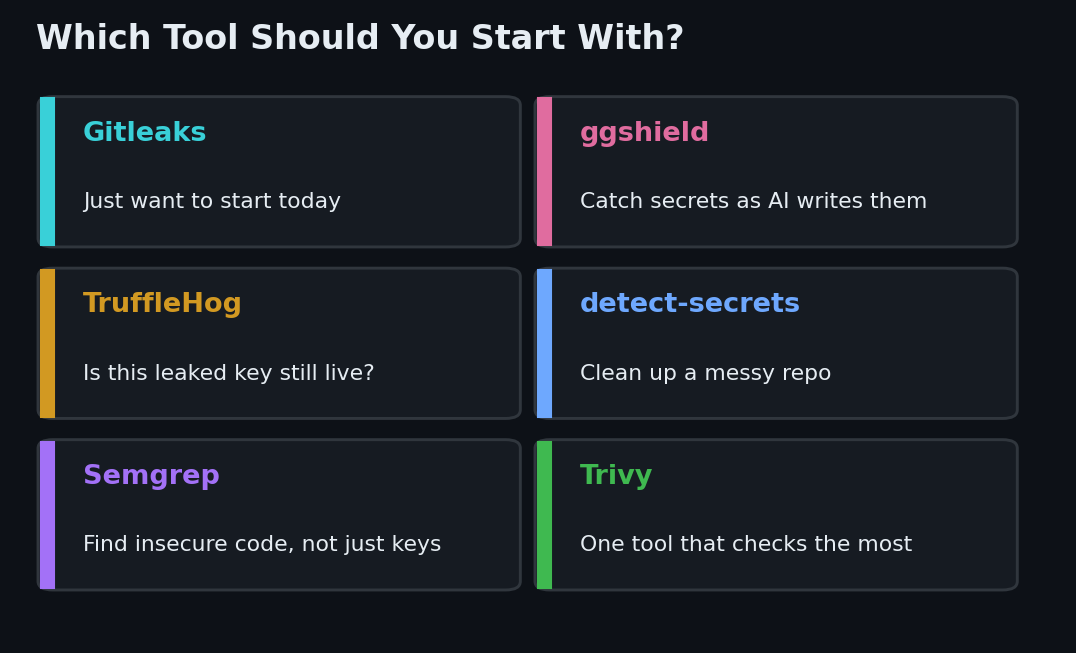
- Just want to start today? Install Gitleaks and run it on your project. Done in two minutes.
- Want it to catch secrets as your AI writes them? Add ggshield.
- Not sure if a flagged key is still dangerous? Use TruffleHog to verify.
- Inherited a messy repo? Baseline it with detect-secrets and clean up over time.
- Worried about insecure code, not just keys? Run Semgrep.
- Want one tool that checks the most at once? Use Trivy.
A great starter combo is Gitleaks running on every commit + Trivy before each deploy. That two-tool setup catches the large majority of "oops, I shipped a secret" mistakes with almost no effort.
Key Takeaway
The scariest vibe coding security problem — leaking an API key — is also one of the easiest to prevent. Pick one scanner, run it before you ship, and rotate anything it finds. Gitleaks is the simplest start, TruffleHog confirms real danger, ggshield guards the AI-assistant step, detect-secrets tames an existing mess, Semgrep catches insecure code, and Trivy checks the most in one go. For the bigger picture on writing safer AI code, read our guide to vibe coding security, and to catch bugs and risky changes in review, see our roundup of AI code review tools.
Star counts, licenses, and release details are approximate and were verified on GitHub in July 2026. Security tools help, but they don't replace understanding your stack — always double-check what your app exposes before going live.
Want a Second Pair of Eyes on Your Code?
Not sure your vibe-coded app is safe to ship? I offer hands-on vibe coding security audits — I'll check your project for leaked API keys, insecure config, and the risky patterns covered above, then send you back a plain-English list of exactly what to fix and how. Email me at [email protected] and I'll take a look.