Spec-Driven Development: How to Make Vibe Coding Reliable in 2026
July 10, 2026 · 1608 words
Spec-driven development is how you keep the speed of vibe coding without the "it looks right but doesn't quite work" tax. Instead of prompting an AI for code and hoping it guessed your intent, you write a precise specification first — then let the coding agent build against it. This guide covers what spec-driven development is, how it differs from plain vibe coding, the four-phase workflow behind it, and the two tools leading the shift in 2026: GitHub Spec Kit and AWS Kiro.
The pattern that motivated it will feel familiar to anyone who vibe codes. As GitHub put it when launching Spec Kit, "you describe your goal, get a block of code back, and often… it looks right, but doesn't quite work." Their diagnosis in the spec-driven development announcement is blunt: we treat coding agents like search engines when we should treat them like literal-minded pair programmers. They're brilliant at pattern completion but can't read your mind. A one-line prompt forces the model to guess at thousands of unstated requirements — and you usually find out which guesses were wrong deep into the build.
What Is Spec-Driven Development?
Spec-driven development (SDD) is a methodology where an executable, version-controlled specification — not the code — is the single source of truth. You describe what to build and why, refine that spec through structured phases, and only then let the AI generate the implementation. The spec isn't a document you write once and abandon; it's a living artifact that drives the code, the task breakdown, and the tests.
The mental shift is captured in one line from GitHub's team: we're moving from "code is the source of truth" to "intent is the source of truth." Specifications matter now not because documentation suddenly got more important, but because AI makes specs executable — when your spec reliably turns into working code, it becomes the thing that actually determines what gets built.
Spec-Driven Development vs. Vibe Coding
Vibe coding and spec-driven development aren't enemies — SDD is what vibe coding grows into when the stakes rise. Kiro's own docs frame it well: developing with specs "keeps the fun of vibe coding, but fixes some of its limitations." Pure vibe coding shines for prototypes and throwaway experiments. It struggles on complex tasks, large codebases, and anything a team has to maintain, because the decisions made along the way are never written down.
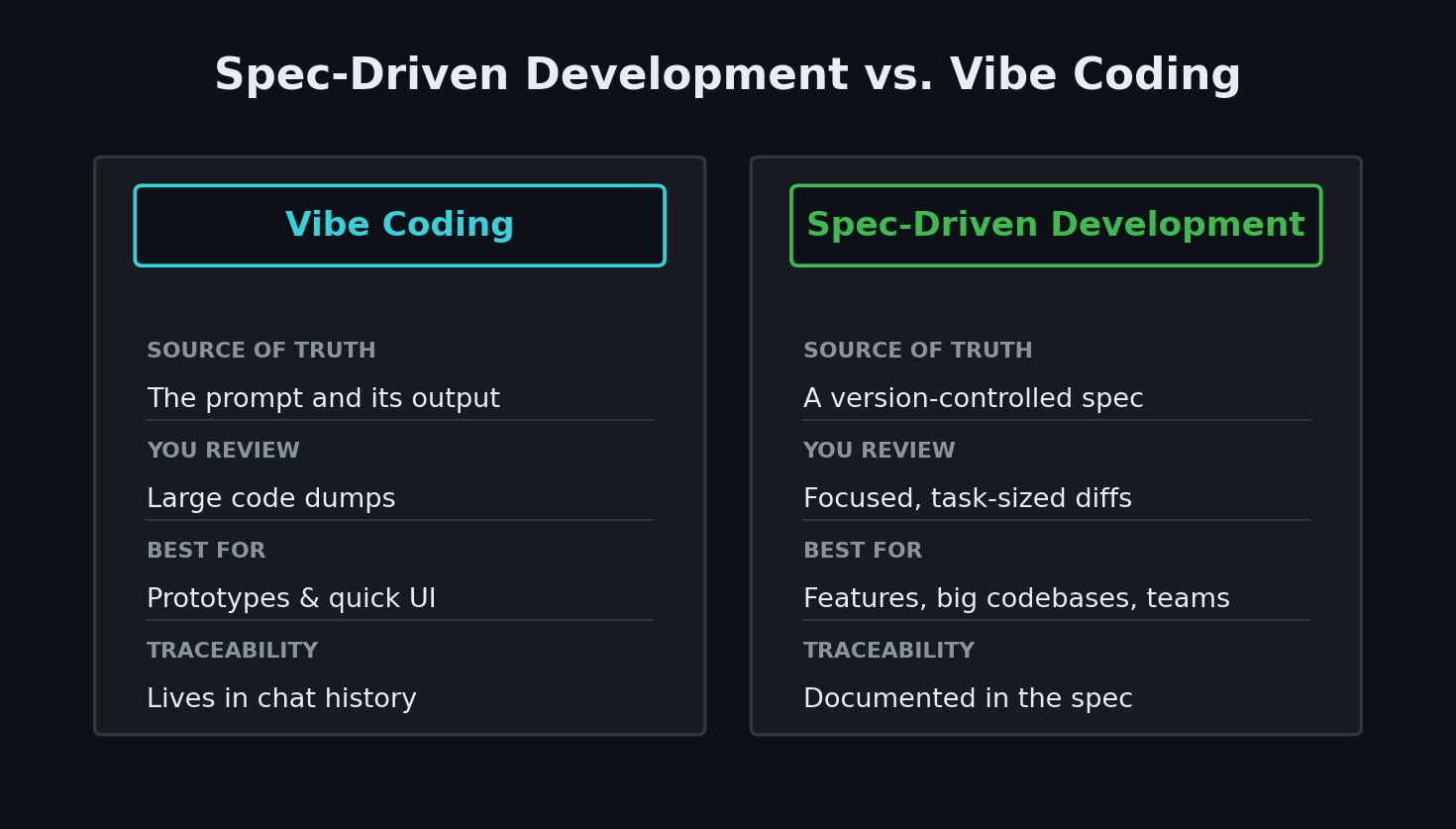
| Vibe coding | Spec-driven development | |
|---|---|---|
| Source of truth | The prompt (and the code it produces) | A version-controlled, executable spec |
| How you steer | Re-prompt until it looks right | Refine the spec, plan, and tasks |
| What you review | Large code dumps | Focused changes tied to a task |
| Best for | Prototypes, throwaway scripts, quick UI | Mission-critical features, big codebases, teams |
| Traceability | Decisions live in chat history | Decisions documented in the spec |
| Failure mode | AI guesses wrong, silently | Gaps surface at a checkpoint before code |
The takeaway isn't "stop vibe coding." It's: match the method to the stakes. Prototyping a landing page? Vibe it. Adding billing to a live SaaS? Spec it.
The Four-Phase Workflow: Spec → Plan → Tasks → Implement
Every SDD toolkit implements roughly the same pipeline. In GitHub Spec Kit the core process ships ready to use as Spec → Plan → Tasks → Implement, and each phase produces a Markdown artifact that feeds the next — giving the agent structured context instead of ad-hoc prompts. Critically, you don't advance to the next phase until you've validated the current one.
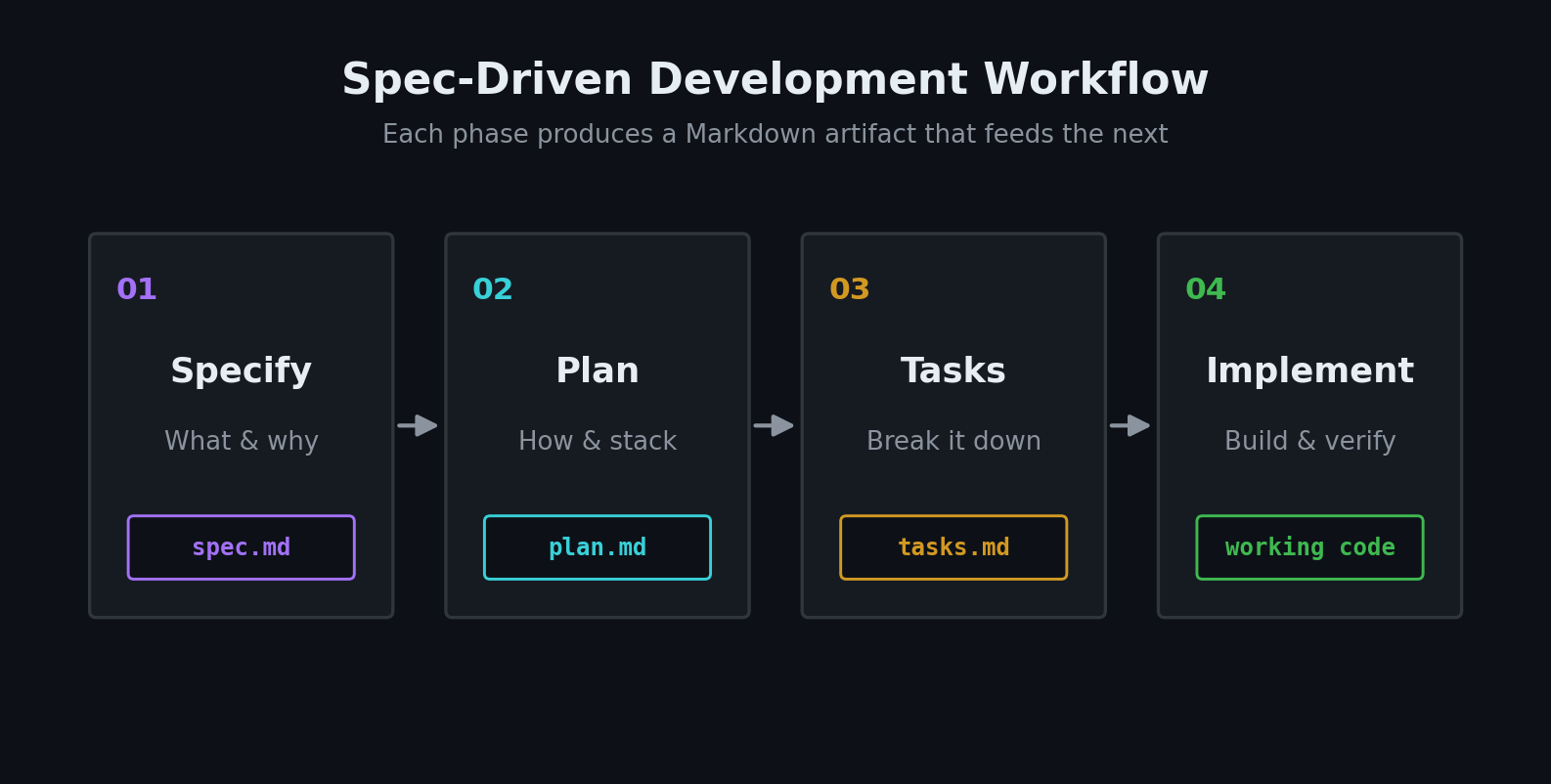
1. Specify — the "what" and "why"
You give a high-level description of what you're building and for whom; the agent generates a detailed spec. This phase is about user journeys and outcomes, not tech stacks. Who uses this? What problem does it solve? What does success look like?
2. Plan — the "how"
Now you get technical. You hand the agent your stack, architecture, constraints, compliance rules, and performance targets, and it produces a technical plan that respects them. This is where "we standardize on Postgres and Next.js" or "must pass SOC 2" stops living in someone's head and becomes something the AI can actually use.
3. Tasks — break it down
The agent turns the spec and plan into small, reviewable, independently testable chunks. Instead of "build authentication," you get concrete tasks like "create a user registration endpoint that validates email format." Each task is something the agent can implement and verify in isolation — almost like test-driven development for your AI.
4. Implement — build and verify
The agent tackles tasks one at a time (or in parallel where possible). Because the spec told it what, the plan told it how, and the task told it what to work on next, you review focused diffs instead of thousand-line dumps. Your job shifts from writing to verifying: at every checkpoint you critique the artifact, spot gaps, and course-correct before moving on.
The Tools: GitHub Spec Kit vs. AWS Kiro
Two tools dominate the 2026 conversation, and they take different shapes. Spec Kit is an open-source CLI that layers SDD onto whatever agent you already use. Kiro is a full agentic IDE from AWS that bakes specs into the editor itself.
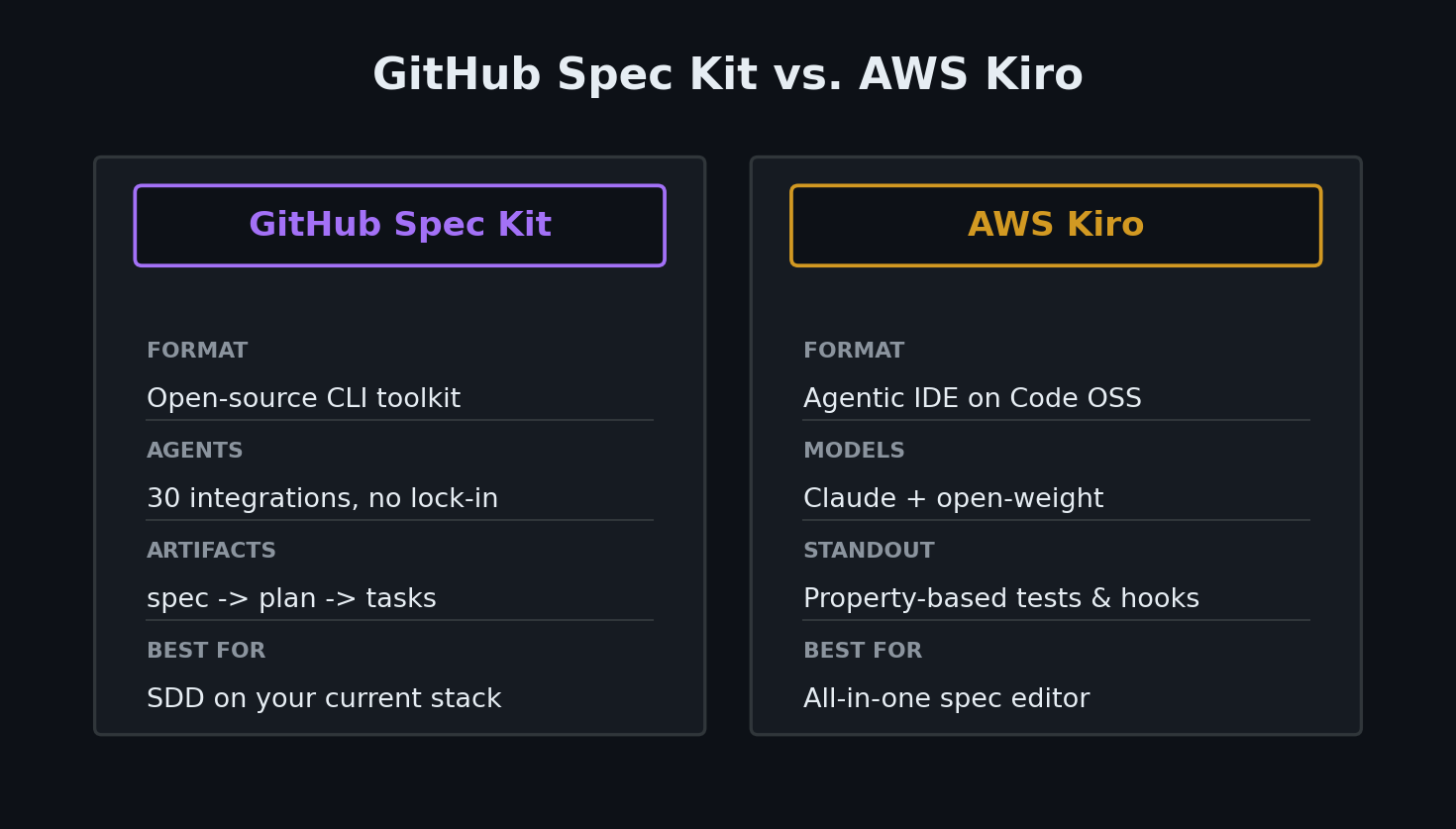
| GitHub Spec Kit | AWS Kiro | |
|---|---|---|
| What it is | Open-source toolkit / CLI | Agentic IDE (built on Code OSS) |
| Setup | specify init in your project | Download the IDE, CLI, or use the web app |
| Agents | Agent-agnostic — 30 integrations (Copilot, Claude, Gemini, Cursor, Windsurf…) | Model selection across Anthropic Claude and open-weight models |
| Artifacts | Markdown spec → plan → tasks | requirements.md, design.md, tasks.md |
| Standout feature | No lock-in; swap agents with one command | Property-based tests + Agent Hooks that automate best practices |
| Best for | Teams who want SDD on their current stack | Teams who want an all-in-one spec-native editor |
GitHub Spec Kit is agent-agnostic by design — run specify init with your agent of choice and it scaffolds the right command files, context rules, and directory structure automatically. AWS Kiro goes further inside the editor: it turns prompts into requirements, an architectural design, and sequenced tasks, then implements them with parallel agents. Kiro also runs property-based tests — which assert rules that must hold across all inputs rather than checking a few examples — to catch the edge cases that pass unit tests but break in production.
A Copy-Paste Spec-Driven Workflow
You don't need a dedicated tool to get most of the benefit. The core discipline — separate the stable "what" from the flexible "how," and validate each phase — works in any coding agent. Here's a minimal version you can paste into Claude Code, Cursor, or Copilot today.
Start by generating the spec, not the code:
Act as a spec author. Before writing any code, produce a SPEC.md for the feature below.

FEATURE: Let signed-in users export their invoices as a CSV.

Cover: user stories, acceptance criteria, edge cases, and out-of-scope items.
Do NOT choose a tech stack yet. Ask me up to 3 questions if intent is unclear.
Once the spec is right, turn it into a plan and then atomic tasks:
Using SPEC.md, write PLAN.md.
STACK: Next.js App Router + Prisma + Postgres. Auth via existing session middleware.
CONSTRAINTS: stream large exports, never load all invoices into memory, respect row-level ownership.

Then write TASKS.md: number each task, make each one independently testable,
and keep each to a single endpoint, function, or component.
Finally, implement one task at a time and review the focused diff before moving on:
Implement TASKS.md #1 only. Show the diff and the test for it. Stop and wait for my review.
This is the same principle we cover in How to Prompt for Vibe Coding: treat every prompt as a mini-spec. Spec-driven development just makes that spec explicit, versioned, and reusable across the whole build.
When Spec-Driven Development Pays Off
GitHub calls out three scenarios where SDD earns its overhead, and they're a useful filter for deciding when to reach for it:
- Greenfield (zero-to-one). A little upfront spec work stops the AI from shipping a generic solution based on common patterns instead of what you actually intended.
- Feature work in existing systems (N-to-N+1). This is where SDD is most powerful. A spec forces clarity on how the new feature interacts with the existing codebase, and the plan encodes architectural constraints so the new code feels native rather than bolted on.
- Legacy modernization. When the original intent is lost to time, you can capture the essential business logic in a fresh spec, design a modern architecture in the plan, and let the AI rebuild without dragging along inherited technical debt.
The common thread: whenever code has to be maintained rather than just demoed, the spec is the artifact that keeps humans and agents aligned.
Key Takeaway
Vibe coding's weakness was never the model's coding ability — it was the ambiguity of a one-line prompt. Spec-driven development fixes that by making intent, not code, the source of truth. Write the spec, derive the plan, break it into testable tasks, and verify each phase before the next. Whether you adopt GitHub Spec Kit, AWS Kiro, or just a disciplined SPEC.md → PLAN.md → TASKS.md habit in your existing agent, the payoff is the same: you keep the speed that made vibe coding addictive, and you finally get code you can trust in production.