7 Best React Native & Expo App Templates and Libraries for Vibe Coders in 2026
July 10, 2026 · 1719 words
The fastest way to vibe code a mobile app in 2026 is to start from a proven React Native Expo template and lean on a handful of battle-tested libraries instead of wiring everything yourself. This roundup covers seven repos — three starter templates and four essential libraries — that let you go from prompt to a running iOS and Android app in an afternoon, ranked by GitHub stars and checked directly on GitHub.
Why templates and libraries matter so much for vibe coders: an AI agent writes far better code when it lands in a project that already has navigation, styling, data fetching, and lists set up the "blessed" way. Give it a skeleton and clear conventions, and every prompt after that is small and safe. Every repo below was opened on GitHub, and the star counts are approximate as of July 2026 — this ecosystem moves fast, so always confirm a project is still active before you build on it.
The Best React Native / Expo Repos at a Glance
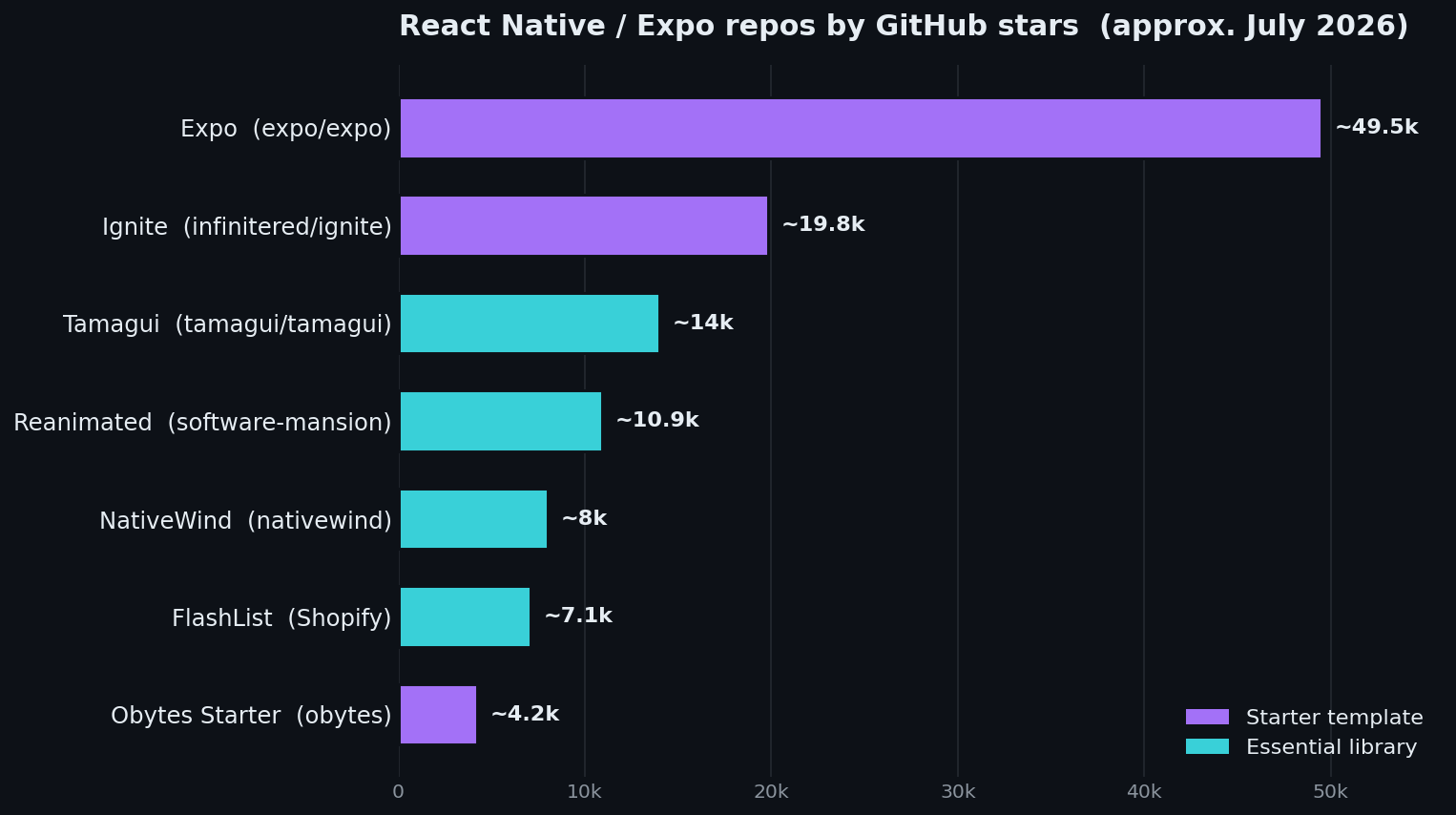
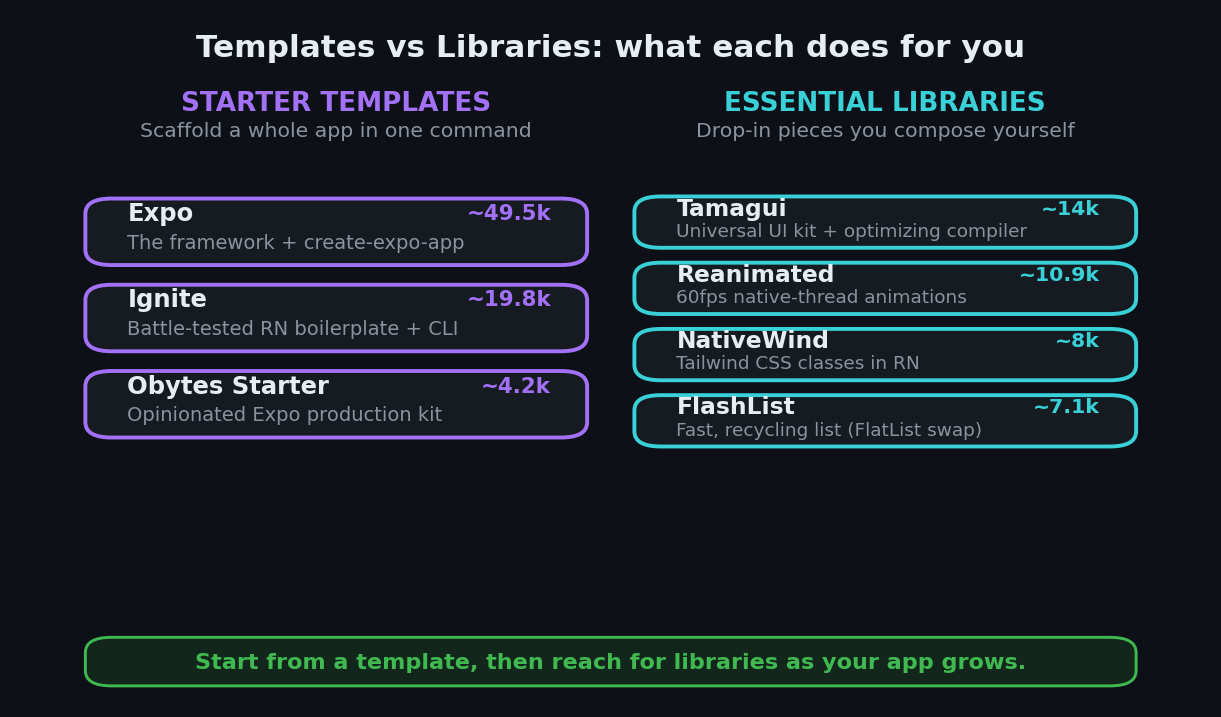
Here's the full lineup, sorted by GitHub stars. Templates scaffold a whole app in one command; libraries are drop-in pieces you compose yourself.
| Repo | Stars (Jul 2026) | Type | What it does | License |
|---|---|---|---|---|
| expo/expo | ~49.5k | Template/Framework | Universal RN framework + create-expo-app starter | MIT |
| infinitered/ignite | ~19.8k | Template | Battle-tested RN boilerplate with a CLI + generators | MIT |
| tamagui/tamagui | ~14k | Library | Universal UI kit + optimizing style compiler | MIT |
| software-mansion/react-native-reanimated | ~10.9k | Library | 60fps animations on the native thread | MIT |
| nativewind/nativewind | ~8k | Library | Tailwind CSS utility classes in React Native | MIT |
| Shopify/flash-list | ~7.1k | Library | Fast, recycling list — a FlatList drop-in | MIT |
| obytes/react-native-template-obytes | ~4.2k | Template | Opinionated, production-ready Expo starter kit | MIT |
1. Expo — the framework and template every RN app should start from
Expo is the ~49.5k-star, MIT-licensed framework that the React Native core team now officially recommends for every new project. It bundles file-based routing (Expo Router), a large standard library of native modules, and a build-and-deploy pipeline, and its create-expo-app command is the default starter template most vibe coders should begin with.
Why it matters to vibe coders: Expo removes the native-tooling pain that used to sink beginner projects. There's no Xcode/Gradle wrangling to get started, and the official docs even include a "build with AI" tutorial — this is the most agent-friendly starting point in mobile.
When to use it: essentially always, unless you have a specific reason not to. Create a project in one line:
npx create-expo-app@latest
The React Native team's own guidance is blunt: "you're either using a framework or you're building your own framework," and as of 2026 Expo is the only recommended community framework. Start here.
2. Ignite — the battle-tested boilerplate for real production apps
Ignite is Infinite Red's ~19.8k-star, MIT-licensed React Native boilerplate — the oldest actively maintained third-party starter, shipping since 2016 and still releasing (v11.5.0 landed in March 2026). It's a full template plus a CLI with component and model generators, and it bakes in opinionated, rock-solid choices: React Navigation, Reanimated, MMKV persistence, apisauce, and Reactotron debugging.
Why it matters to vibe coders: Ignite encodes years of agency experience into conventions your AI agent can follow. Generators mean you say "make a new screen" and get a consistent, test-ready file every time, instead of seven slightly different patterns.
When to use it: you're building something you intend to ship and maintain, and you want structure over a blank canvas. Spin up a new app:
npx ignite-cli@latest new PizzaApp
3. Tamagui — a universal UI kit that compiles away its own overhead
Tamagui is a ~14k-star, MIT-licensed style library, design system, and optional UI kit that hits 100% parity across React and React Native. Its headline feature is an optimizing compiler that flattens styled components into plain views plus atomic CSS on web, so you get a clean developer experience without the usual runtime cost.
Why it matters to vibe coders: you describe a screen and get accessible, themeable components that look right on iOS, Android, and web from a single codebase. That "write once, ship everywhere" leverage is exactly what makes a small team (or a solo vibe coder) feel like a big one.
When to use it: you want a polished, shared design system across native and web, or you're building a universal app. Scaffold a starter:
npm create tamagui@latest
4. React Native Reanimated — buttery animations without the jank
React Native Reanimated from Software Mansion is the ~10.9k-star, MIT-licensed standard for animations in React Native, now on version 4 (released June 2026) and built for the New Architecture. It runs animations and gestures on the native UI thread via worklets, so interactions stay smooth even when your JavaScript is busy.
Why it matters to vibe coders: animation is where naive code drops frames. Reanimated lets you (or your agent) express complex, spring-based motion declaratively and get 60fps for free — the difference between an app that feels "cheap" and one that feels native.
When to use it: any time you want gestures, transitions, or micro-interactions beyond a basic fade. It ships in most templates already; to add it manually with Expo:
npx expo install react-native-reanimated
5. NativeWind — Tailwind CSS classes, straight into React Native
NativeWind is the ~8k-star, MIT-licensed library that brings the Tailwind CSS utility-first workflow to React Native. It's a styling engine, not a component library: it processes your classes at build time and applies a minimal runtime for reactive styles like dark mode, media queries, and container queries, using the best style system for each platform.
Why it matters to vibe coders: LLMs are extremely fluent in Tailwind. If your app styles with className="flex-1 items-center bg-slate-900", your agent produces correct, idiomatic layouts on the first try far more often than with hand-rolled StyleSheet objects.
When to use it: you like Tailwind and want the same muscle memory on mobile. Spin up a pre-configured Expo project, or add it to an existing one:
# new project
npx rn-new@latest --nativewind
# existing project
npm i nativewind
6. FlashList — a faster list you can swap in seconds
FlashList from Shopify is the ~7.1k-star, MIT-licensed list component that fixes React Native's biggest performance pain point. Now on v2 (released June 2026, rebuilt as a JS-only solution for the New Architecture), it uses view recycling to kill blank cells and hold 60fps through thousands of items — and v2 no longer needs size estimates.
Why it matters to vibe coders: almost every app has a feed, a chat, or a product list, and the default FlatList chokes under load. FlashList is a near drop-in replacement, so you get "instant performance" without your agent needing to understand virtualization internals.
When to use it: any scrollable list of non-trivial length. Add it and change one import:
npx expo install @shopify/flash-list
If you already know FlatList, you already know FlashList — swap the component name and go.
7. Obytes Starter — an opinionated, production-ready Expo kit
Obytes React Native Template is a ~4.2k-star, MIT-licensed Expo starter (v9.0.0, January 2026) that wires together the modern stack most teams converge on: Expo Router, NativeWind, FlashList, React Query, TanStack Form with Zod, i18next, Zustand + MMKV auth, and 10+ GitHub Actions workflows. Its README explicitly calls out that the structure "works well with AI coding tools."
Why it matters to vibe coders: it's a curated bundle of several other repos on this list, pre-integrated and CI-ready. Instead of gluing eight libraries together yourself, you inherit a coherent architecture your agent can extend safely.
When to use it: you want batteries-included defaults and don't want to make a dozen setup decisions. Scaffold it from the GitHub template:
npx degit obytes/react-native-template-obytes MyApp
How to Choose Your React Native / Expo Stack
There's no single "best" repo — you'll combine a template with a few libraries. Use this quick decision guide:
- Starting fresh and unsure: run Expo's
create-expo-appand add libraries as you need them. This is the right default for 90% of vibe coders. - Shipping a serious, maintained app: start from Ignite for its generators and conventions, or Obytes for a batteries-included, CI-ready stack.
- Styling: pick NativeWind if you and your agent think in Tailwind, or Tamagui if you want a universal design system with a compiler.
- Polish and performance: add Reanimated for animations and FlashList for any real list. These two belong in almost every app.
Notice how the templates already pull in the libraries — Ignite ships Reanimated, and Obytes ships NativeWind, FlashList, and Reanimated. That's the whole point: a good template hands your AI agent a house that's already framed, so each prompt just decorates a room. The same "small, reviewable steps" discipline that works everywhere applies here too, and it's worth pairing this stack with the habits in our guide on how to prompt for vibe coding.
Key Takeaway
For vibe coding a mobile app in 2026, the winning move is simple: begin with Expo (the officially recommended framework), reach for Ignite or the Obytes starter when you want more structure, then layer in NativeWind or Tamagui for styling, Reanimated for motion, and FlashList for lists. Each repo above is MIT-licensed, actively maintained, and agent-friendly — so you get native-quality apps at the speed of a prompt.
Star counts and project statuses are approximate and were verified on GitHub in July 2026; this fast-moving space changes often, so check each repo before you commit to it.