6 Open-Source AI Coding Agents on GitHub Every Vibe Coder Should Know in 2026
July 10, 2026 · 1496 words
Open-source AI coding agents let you vibe code with a self-hostable, model-agnostic tool instead of renting a closed black box. This roundup covers the six most important ones on GitHub right now — what each is best at, how many stars it has, and which one fits your workflow — so you can pick without reading a dozen READMEs. Every repo below was checked directly on GitHub, and the star counts are approximate as of July 2026.
Why open source? You can read the code, run it against local models, avoid per-seat lock-in, and extend it with your own tools. The trade-off is churn: this space moves fast, projects get renamed, forked, or archived, and a repo that was hot six months ago may be read-only today. That's exactly why the first thing to check on any agent is whether it's still actively maintained — a lesson the last entry on this list makes concrete.
The Open-Source AI Coding Agents at a Glance
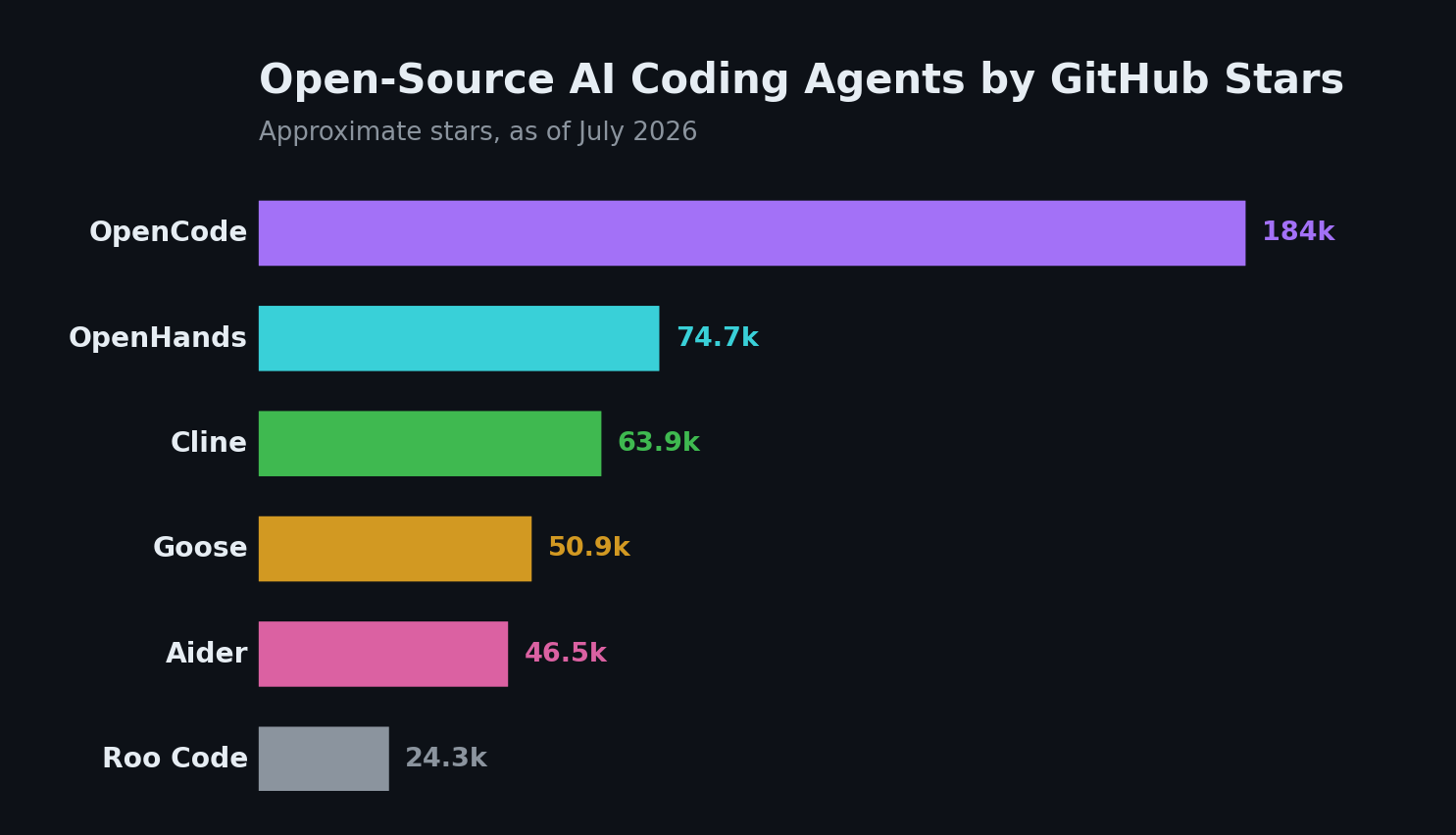
Here's the full lineup, sorted by GitHub stars. Use it as a cheat sheet, then jump to the section for whichever fits your setup.
| Repo | Stars (Jul 2026) | Best for | Language | License |
|---|---|---|---|---|
| OpenCode | ~184k | Terminal-first, model-flexible coding | TypeScript | MIT |
| OpenHands | ~74.7k | Autonomous, feature-sized tasks | Python | MIT |
| Cline | ~63.9k | VS Code / JetBrains with human-in-the-loop | TypeScript | Apache-2.0 |
| Goose | ~50.9k | On-machine agent beyond just code | Rust | Apache-2.0 |
| Aider | ~46.5k | Git-native pair programming in the terminal | Python | Apache-2.0 |
| Roo Code | ~24.3k | Reference/history (archived May 2026) | TypeScript | Apache-2.0 |
1. OpenCode — the most-starred terminal agent
OpenCode (formerly hosted at sst/opencode) is the highest-starred open-source coding agent on GitHub, at roughly 184k stars and MIT-licensed. It's a terminal-native agent with a polished TUI, built-in build and plan agents you switch between with a keypress, and support for a huge range of model providers.
Why it matters to vibe coders: it's fast, keyboard-driven, and model-flexible, so you're never locked to one vendor. The read-only plan agent is perfect for exploring an unfamiliar codebase before you let it touch anything.
When to use it: you live in the terminal and want the most active, community-backed option. Install it in one line:
curl -fsSL https://opencode.ai/install | bash
# or: npm i -g opencode-ai@latest
One caveat that proves the "check maintenance" rule: OpenCode's GitHub org was renamed (the old sst/opencode URL now redirects), so always confirm you're installing from the official opencode.ai source.
2. OpenHands — autonomous agent for bigger jobs
OpenHands (formerly OpenDevin) is an MIT-licensed, ~74.7k-star platform for agents that "do anything a human developer can" — edit code, run commands, browse the web, and call APIs. It ships as a Python SDK, a CLI, a local GUI, and a hosted cloud, and it posts a strong 77.6% score on SWE-bench, an industry benchmark for resolving real GitHub issues.
Why it matters to vibe coders: OpenHands is built for autonomy. You hand it a feature-sized task and it works through the steps inside an isolated Docker runtime, which makes it safer to let off the leash than an agent running directly on your machine.
When to use it: you want to delegate a whole ticket ("add pagination to the products API and tests") rather than pair line-by-line. Start with the CLI:
uvx --python 3.12 --from openhands-ai openhands
3. Cline — the IDE agent that asks first
Cline is the go-to open-source agent for editor-first workflows, with ~63.9k stars and an Apache-2.0 license. It runs as a VS Code and JetBrains extension, plus a CLI and SDK, and its signature feature is Plan/Act mode: Cline explores and proposes a plan, then executes it with every file edit and terminal command gated behind your approval.
Why it matters to vibe coders: the human-in-the-loop design means you stay in control and can review a diff before anything changes — a sane default when you don't fully trust the model yet. It's also model-agnostic (Anthropic, OpenAI, Google, local models via Ollama/LM Studio) and speaks MCP for custom tools.
When to use it: you want AI inside your editor with checkpoints and diffs, not a terminal firehose. Install from the VS Code Marketplace, or:
npm i -g cline
Cline's approach — describe intent, review the plan, then let it act — pairs perfectly with the mini-spec habits in our guide on how to prompt for vibe coding.
4. Goose — an on-machine agent that goes beyond code
Goose is a ~50.9k-star, Apache-2.0 agent originally from Block and now governed by the Linux Foundation's Agentic AI Foundation. Built in Rust for speed and portability, it's a native desktop app plus a full CLI and API, and it works with 15+ providers and 70+ MCP extensions.
Why it matters to vibe coders: Goose isn't limited to code — it can run commands, automate workflows, do research, and test its own changes, all on your machine. Because it's a general-purpose agent, it's handy for the glue work around a project (scripts, data wrangling, migrations), not just the app itself.
When to use it: you want one local agent for coding and automation, and you like the idea of an open, foundation-governed project. Install the CLI:
curl -fsSL https://github.com/aaif-goose/goose/releases/download/stable/download_cli.sh | bash
5. Aider — git-native pair programming
Aider is the veteran terminal pair programmer, at ~46.5k stars and Apache-2.0. It maps your entire repo, works across 100+ languages, and — its killer feature — automatically commits each change with a sensible message, so every AI edit is a clean, reviewable point in your git history you can diff or undo.
Why it matters to vibe coders: the tight git integration turns "the AI changed something and I don't know what" into an ordinary code review. Aider is also frequently the tool other agents benchmark against, and it connects to almost any cloud or local LLM.
When to use it: you want surgical, version-controlled edits from the command line with zero editor lock-in. Get started:
python -m pip install aider-install && aider-install
aider --model sonnet --api-key anthropic=<key>
6. Roo Code — a cautionary tale (now archived)
Roo Code earned ~24.3k stars as a popular fork of Cline that added a structured multi-mode system (Code, Architect, Ask, Debug). It's here not as a recommendation but as a lesson: the repository was archived on May 15, 2026 and is now read-only, with the team pivoting to a cloud product.
Why it matters to vibe coders: it's a reminder to check the pulse of any repo before you build on it — last commit date, latest release, and open-issue activity. A 24k-star project can still go dormant. If you liked Roo Code's modes, the community started a fork, and its lineage traces back to Cline (#3 above), which is very much alive.
How to Choose Your Open-Source AI Coding Agent
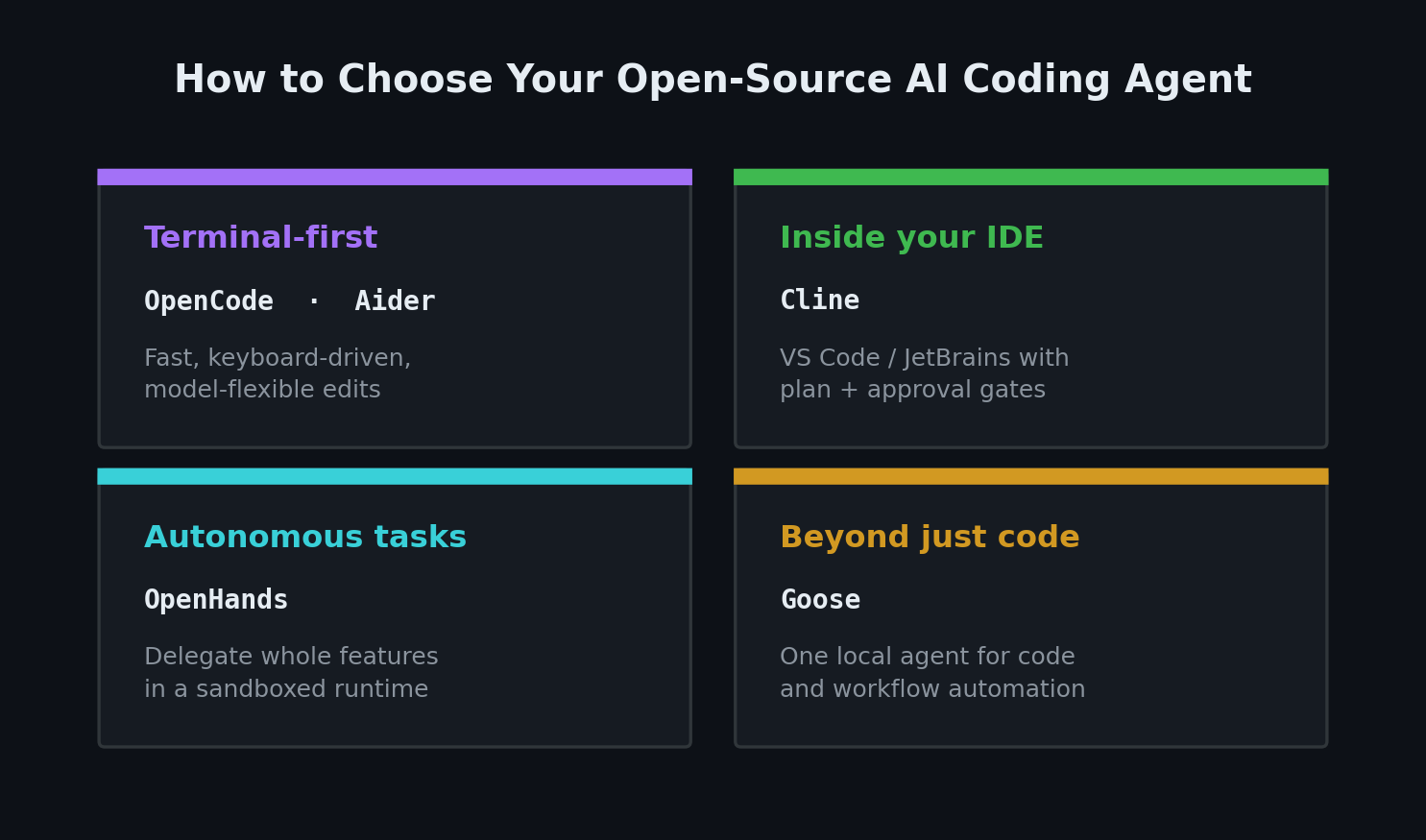
There's no single winner — the right pick depends on where you work and how much autonomy you want. Use this quick decision guide:
- You live in the terminal: start with OpenCode (most active, model-flexible) or Aider (git-native, surgical edits).
- You want AI inside VS Code / JetBrains: choose Cline for its plan-first, approval-gated workflow.
- You want to delegate whole features autonomously: run OpenHands in its sandboxed Docker runtime.
- You want one local agent for code and automation: pick Goose.
Whatever you choose, the fundamentals of getting good output are the same across every tool: load context, prompt in small slices, review each diff, and keep your intent explicit. If you want the workflow that makes any of these agents reliable, read our guide on how to prompt for vibe coding.
Key Takeaway
The open-source coding agent ecosystem in 2026 is deep and genuinely competitive: OpenCode leads on stars and terminal polish, OpenHands owns autonomous feature work, Cline is the safest IDE default, Goose goes beyond code, and Aider keeps everything clean in git — while Roo Code reminds us to verify a project is still alive. Pick one that matches your editor and your appetite for autonomy, confirm it's actively maintained, and you get the speed of vibe coding on tooling you fully own.
Star counts and project statuses are approximate and were verified on GitHub in July 2026; this fast-moving space changes often, so check each repo before you commit to it.